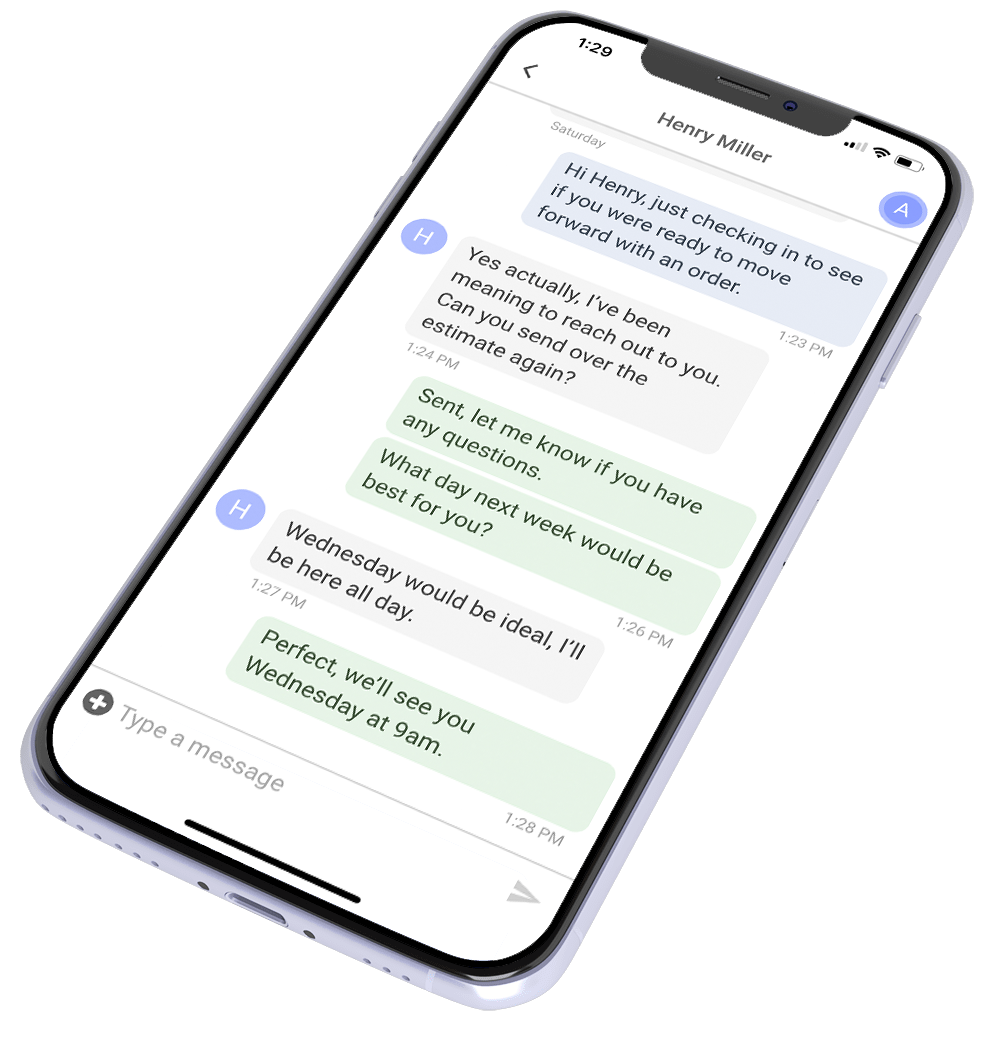
Most roofing contractors don’t start shopping for a new CRM out of pure curiosity. The truth is that something has been quietly not working long enough that the pain of staying has finally outweighed the pain of switching. At the very least, you’re thinking that there might be something out there that might better meet your needs.
This article maps the full landscape of roofing CRM software. It covers where each type of roofing CRM came from, what it does well, where it tends to disappoint, and who it actually fits. We aren’t going to name our competitors. But if you’ve spent any time in this space, your brain might make some connections!

What Is a Roofing CRM?
CRM stands for customer relationship management. In roofing, that means…
- Tracking leads
- Managing follow-up
- Sending quotes
- Scheduling appointments
- Ordering labor and materials
- Invoicing
- Generating reviews
- Keeping every conversation with every homeowner in one place
Most CRMs fall into three classic categories.
- Operational CRMs handle time-consuming business tasks and workflows.
- Analytical ones turn pipeline and performance data into insights.
- Collaborative CRMs connect teams around shared customer information.
A CRM that does all three well is powerful. A CRM that only does one is a niche tool built for a specific problem, and niche tools aren’t bad things as long as you know what you bought. Most roofing CRMs are operational CRMs. They try to move all of your daily work to one platform. Some prioritize measurement operations. Others prioritize insurance. But on the whole, most CRMs will seek to smooth out some or most of your internal operations.
The roofing industry has quietly added a fourth category that the traditional framework doesn’t account for: communication-first. It’s about time.
The relationship part of customer relationship management is often overlooked. That’s a huge problem, because roofing is a relationship industry. Roofs are expensive. You need to win the trust of homeowners to win their business, which means building a relationship. And if you ask anyone who’s been happily married for fifty years what their relationship secret is, they’ll say communication.
In caveman terms, relationships mean more sales. Communication means more relationships. Therefore, communication means more sales. So a communication-first CRM will help you sell more jobs. Simple, right?
Communication = Relationships = Sales
That’s in the short-term. Long-term, communication turns sales into five-star reviews and referrals. Those create even more opportunities to grow your business and create generational wealth for your family.
But not every roofing CRM is built around communication.
Where Roofing CRM Software Comes From
Every roofing CRM started with someone who saw a gap in the roofing software world. The question worth asking is which gap, because that shapes everything.
Here’s a breakdown of every major type of roofing CRM on the market today, where each came from, and which roofer each one actually fits.
The My-Way-or-the-Highway Roofing CRM
Some roofing platforms were built around one very specific way of running a roofing business. The workflow is set. The pipeline stages are defined. If your operation aligns with how the software assumes you work, the experience can be powerful. It feels like you’ve found a CRM that gets you and your business.
Where It Came From
These platforms were built by industry pros who modeled software on their own processes. The conviction was that if it worked for them, it would work for everyone. For contractors who fit the mold, that conviction was often right.
What It Gets Right
These are typically the oldest platforms in the space, and time ‘in market’ always comes with benefits, like a…
- Mature feature set
- Large user community
- Knowledge base built from years of real-world use
- Track record that newer platforms haven’t had time to build.
When you run into a problem, someone else has already solved it and documented the answer.
Common Complaints
The rigidity that makes these platforms powerful for some contractors makes them frustrating for others. So the very thing that makes these so powerful stabs you in the back if you don’t run your business a certain way. Customization is limited by design. If your market calls for something different, you’ll spend a lot of time fighting the software.
Communication features exist as an afterthought on these platforms. They were added because the market eventually demanded them. You can feel the difference between a feature built from the ground up and a feature that was retrofitted years after launch.
After about six months, the people using the software find problems they didn’t see in the demo. This happens because the demos use pre-prepped pages. They don’t show how long the software really takes to work. The system works until it doesn’t, and finding support when it stops working is often harder than it should be.
Best For
Roofing contractors running largely insurance-restoration operations who want a proven system with an established user base and are willing to adapt their process to match the platform rather than the other way around.
Before You Buy
Walk through a demo with your actual workflow, not a generic one. Ask about the three features your process needs and learn what workarounds look like in practice. Then ask what’s been improved for existing customers in the last two years.
The Jack of All Trades Roofing CRM
These platforms can technically do almost anything. They come with lead tracking, job management, basic communication, and some automation. For a contractor who’s fed up with the rigidity of the established incumbents, they look like the obvious alternative. Because of that, they’re often the number two option for roofers looking for a CRM.
Where It Came From
These platforms came up alongside the most established players. They serve as the relief valve for contractors who didn’t fit the rigid mold. They absorbed years of frustration and offered something more custom. If a small company wanted a basic program and didn’t want people telling them what to do, the one that’s okay at everything was the escape they needed.
What It Gets Right
For what it is, the platform delivers. These tools tend to be:
- Easier to get started with than the incumbents
- Less expensive at the entry level
- Less prescriptive about how your workflow has to look
If you need basic CRM functionality to hold a smaller operation together and you’re not yet relying on automation to drive follow-up and close rates, this kind of platform does the job.
Common Complaints
The ceiling comes fast. You realize that the features you need to scale don’t work well enough to change your business.
The pattern most contractors describe goes like this. You sign up feeling good about the flexibility. Then, you spend two or three months trying to build out the workflows you actually need. Somewhere around month four, you realize you’ve been running in circles. The platform can do it, technically. But getting it to do it reliably at volume feels like getting a cavity filled by a gorilla armed with a jackhammer.
Best For
Smaller roofing companies that want a popular alternative to the biggest names in the industry.
Before You Buy
Ask for a live demo that shows what happens when a lead goes cold for 72 hours. What fires automatically? What requires a human to remember? What will it take to set up every automation for my business?
The Measurement-Forward Roofing CRM
Some roofing platforms started as measurement products, and the CRM features came later. The core product was always speed and accuracy in the pre-inspection phase. If your sales process runs on getting an aerial report back before you’ve even scheduled the inspection, this one probably caught your attention early.
Where It Came From
The founding assumption was that the most painful part of the roofing sales process is ordering measurements. If you can pull measurements before you get on the roof, you could move faster than competitors and close more jobs.
What It Gets Right
For contractors whose sales process is built around pre-inspection measurements and instant estimates, the integration between measurement and quoting delivers value. An aerial report that flows directly into a proposal saves real time and eliminates a real point of friction. The platform earns its place in the pre-sale workflow.
Common Complaints
Measurements are one of many pre-sale tools. An instant estimate without communication or speed-to-lead doesn’t build as much trust as you’d think. You need both in tandem to prove yourself to the homeowner. And yes, measurements are important for your bottom line. But your homeowner isn’t concerned about your measuring tools. They care about fixing their roof. Unless you can bridge that gap with communication, you’re stuck with an internal process tool calling itself a CRM.
Best For
Contractors whose primary sales advantage is speed and accuracy in the pre-inspection phase, but are willing to automate follow-up with an outside platform.
Before You Buy
Map out your complete post-sale customer journey, from signed contract through final payment and review request, and ask the platform to walk you through exactly how each of those touchpoints works.
The Communication-First CRM
Every CRM category in this article was built around a specific operational problem. Scheduling. Job tracking. Measurements. Document storage. The logic in each case was the same: fix the broken process, and the business improves.
All those other types of roofing software didn’t think about this. The biggest problem that costs the most money is about people. Roofing is one of the largest and most disruptive purchases a homeowner ever makes. They’re scared. They don’t know who to trust. And the contractor who wins their business is almost never the cheapest or the most technically impressive. It’s the one who made them feel taken care of from the first interaction.
Communication is what does that. Roofing contractors have always known this. The ones running great operations have tried to solve it. Some bolted a communication tool onto their operations CRM and hoped the integration held. Some built Frankenstein stacks with Zapier, a phone system, an email tool, and a texting platform. Some bought a white-label marketing tool and tried to run their sales process through a funnel builder.
Nobody had built a roofing CRM with communication as the foundation. So that’s what ProLine set out to build.
Where It Came From
John DeLaurier ran a roofing company for almost ten years. He brought in AJ Briley to help generate more leads. The leads came. And then the operation fell behind because there was no system to respond to all of them.
You already know the feeling. A lead comes in, your team gets to it when they can, and a few days later you find out they went with someone else because they called back faster.
AJ built a communication system to solve that problem. Today, that system is ProLine.
What It Gets Right
Every rep on your team gets a dedicated local phone number matched to the area code of the market they’re working. All calls, texts, and voicemails flow through that number, show up in the app, and log automatically to the right job record. Homeowners answer local numbers. They don’t answer 800 numbers and five-digit short codes.
Two-way email sync means outbound emails look like personal emails from your rep. When the homeowner replies, that reply logs to their job record automatically.
Call recordings and transcripts let you coach your sales team on their follow-up without sitting on every call. The AI voice agents handle inbound and outbound calls around the clock. A lead that comes in at 10 PM on a Saturday doesn’t sit cold until Monday morning.
The automation handles what most roofing contractors run manually and inconsistently. New lead in, first contact fires immediately. Quote sends, follow-up sequence starts. Inspection confirmed, reminder sends automatically. Invoice paid, review request triggers. All of it runs without anyone having to remember to do it.
Common Complaints
Insurance restoration workflows are still in development. If heavy supplement work is your primary business model, ProLine isn’t fully built for that yet, and the team will tell you so before you sign.
Best For
Residential retail and hybrid insurance-retail roofing contractors in the $3 million to $20 million range running a homeowner-driven operation where reps are in the field, on their phones, presenting to homeowners, and close rate is directly tied to how fast follow-up happens.
Before You Buy
Ask your current CRM what happens when a lead comes in at 10 PM on a Saturday. Ask specifically what fires automatically and what waits until Monday morning. That answer usually tells you everything else you need to know.
The Disappointment CRM
Some CRMs arrive carrying enormous promise. The positioning is right. The timing is right. Contractors who’d been burned by the incumbents are ready to believe, and the platform gives them a reason to. These CRMs are supposed to be “The One.” Then the product shipped, and the difference between what was promised and what was delivered was hard to ignore. People stay anyway, because switching CRMs is painful enough that “good enough” beats “start over.”
Where It Came From
These platforms often come from an acquisition or a merger between two tools that each did something well. The theory was that combining them would produce something best-in-class. Combining two codebases is harder than it sounds. The resulting product often feels like two things stitched together rather than one thing built with intention.
What It Gets Right
The combined feature set is genuinely broader than either tool alone. For contractors who need both CRM functionality and a dedicated sales tool under one roof, the promise of that combination is real.
Common Complaints
Support isn’t good. If something breaks, they can’t get help fast. The problem gets bigger, and roofing businesses lose jobs or sales because of it.
Contractors on these platforms frequently describe how the two codebases don’t connect. The integrations remain half-baked. The original team that built the tools gets gutted and replaced by the acquisition firm’s own staff or the private equity groups backing them.
Living with the pain of what these platforms were supposed to be and what they actually are feels painful. Things that were supposed to work together often require manual steps in the middle.
Best For
Contractors who have built their workflow so deeply around these tools that the switching cost outweighs the frustration. At least, until they fully understand the full cost of staying.
Before You Buy
Ask to speak with a current customer who’s been on the platform for at least two years or through the acquisition. Ask them specifically what happened the last time something broke and how long it took to get resolved. Also, ask them how long until the platforms integrate. Their answer will tell you more than any demo.
The Industry Outsider CRM
A category leader in another trade decides roofing is next. They’ve already dominated two or three verticals. The logic is compelling. Great field service software is great field service software. For contractors coming from PE-backed portfolios that already use this platform, it feels natural. If it worked over there, it’ll work here.
Where It Came From
These platforms weren’t built for roofing. They were built for field service businesses at the enterprise, franchise, or roll-up scale in other trades. If a portfolio company thrived with this platform in another vertical, the operations team is going to push to use it again. The devil you know is often easier to dance with than the one you don’t know. Roofing gets pulled in not because the platform fits roofing specifically, but because it fits the portfolio.
What It Gets Right
Scale and infrastructure. These platforms have enterprise-grade architecture, robust reporting, and the operational depth that comes from serving large, complex field service businesses for years. If you’re running a multi-branch, multi-market roofing company and you need serious operational horsepower, the underlying platform can support it.
Common Complaints
Roofing-specific workflows feel like an afterthought on these platforms, because they were. Measurement integrations are limited or nonexistent. Residential roofing sales look nothing like the trades these platforms were built for. The software reflects that mismatch. Contractors who move here from roofing-native tools often spend months rebuilding workflows.
Best For
Multi-vertical PE-backed operations where standardization across trades outweighs roofing-specific optimization.
Before You Buy
Ask how many roofing contractors are actively using the platform and request a reference from one doing retail residential at your volume. The distance between “we support roofing” and “we’re built for roofing” is a long, bumpy drive.
The General Trades CRM
These platforms were built for the trades broadly. Roofing falls under that umbrella, technically. For contractors who’ve spent years in another trade before starting a roofing company, these tools feel like home. You already know how to use it. Learning a whole new platform when you’re already building something new sounds like a problem for later.
Where It Came From
The assumption was that field service businesses share enough common problems that one platform could serve all of them reasonably well. That assumption is sometimes correct. The issue is that “reasonably well” for plumbing and “reasonably well” for roofing involve different things.
What It Gets Right
These platforms handle the business fundamentals well:
- Job management and scheduling
- Invoicing and customer records
- The operational backbone most contractors already know how to use
If you’re coming from a construction background and you want a familiar foundation while you build a roofing operation, the baseline functionality holds up.
Common Complaints
Roofing has quirks that general trades platforms weren’t designed for. Measurement report integrations are often missing or bolted on awkwardly. The same thing often goes for supplier integrations. Insurance restoration workflows don’t exist. The communication layer is basic at best, non-existent at worst.
People who sell roofs often have to find extra steps to make these tools work for them. Roofing software would do it easily. A lot of times, a person used this kind of app for construction first. They brought it to their new roof company because it was the one they knew. They tried for a year and a half to make it work, but it couldn’t. Then they finally got a different program.
Best For
Contractors running multi-trade operations who need consistency across all their businesses and are willing to accept roofing-specific limitations in exchange for that consistency. If you decide to settle for a general trades CRM, make sure roofing accounts for less than 20% of your total volume. Otherwise, you’ll spend more time fighting the software than actually running your business.
Before You Buy
Pull up your last ten roofing jobs and trace every touchpoint from lead intake through the review request. Ask the platform to show you where each step lives and what happens at each one. What a general trades CRM can’t do for roofing almost never shows up in a demo. It shows up three months in.
The Enterprise CRM
Some roofing contractors land on the platforms that dominate global sales organizations. These tools show up on every Fortune 500 software stack. These platforms are the backbone of global corporations with massive headcounts. The logic seems sound. If a software stack works for the Fortune 500, it should easily handle a $10 million roofing company.
Where It Came From
Enterprise CRMs were built for analytical and collaborative use cases at a massive scale. They help Fortune 500 titans manage complex pipelines across enormous sales teams. They’re extraordinary tools for the problems they were designed to solve.
What It Gets Right
These platforms deliver on reporting depth and pipeline visibility like nothing else on the market. If you want to examine your data from every conceivable angle, these are for you. The integration ecosystem is also enormous. You can connect almost any other tool you use.
Common Complaints
Getting these platforms to work for roofing takes months of configuration. It also often costs thousands of dollars. There are no native measurement integrations. The roofing sales workflow doesn’t exist out of the box. Setting up the enterprise CRM for selling roofs costs so much, it’s more than the cost of roofing software for two whole years.
Local phone numbers, two-way texting, and automated follow-up sequences can be added later. But they aren’t coded into the DNA of the system. It requires a massive amount of effort to bolt on the features you need to sell more jobs.
Best For
Roofing companies with complex multi-department operations, dedicated IT or operations staff to manage platform configuration, and enough scale that enterprise-grade reporting actually changes how decisions get made.
Before You Buy
Ask your implementation partner for a specific timeline and full cost estimate to get the platform running your actual roofing workflow. Then get a second opinion on that estimate from someone doing more business than you.
The Frankenstein CRM
No single CRM does exactly what you need, so you build your own from parts. A spreadsheet connects to your email tool through Zapier, N8N, or Make.com. Your email tool connects to your scheduling app. Your scheduling app connects to your invoicing software. Six months in, you’ve got twelve tools talking to each other through a web of automations that one person on your team understands, and that person is you. You’ve seen the monthly pricing on purpose-built platforms. You know what Zapier can do. The math on building your own doesn’t seem crazy.
Where It Came From
The Frankenstein CRM starts with a reasonable idea. If you can get the same functionality by connecting inexpensive tools, why pay for an all-in-one platform? The math works out on a whiteboard. Plus, roofing business owners are do-it-yourself people. They wouldn’t have started businesses if they weren’t! So if you started a roofing company to do things your way, why not build out your software stack for the same reason?
What It Gets Right
The cost case is real, at least initially. If you’re good with computers and have time to set up and take care of software, you can get many features for less money at the start than CRM. Some contractors build impressive systems this way and run them for years.
Common Complaints
Every integration is a potential failure point. Zapier has an outage. A tool updates its API. Something in the chain breaks without warning, follow-up stops going out, and you don’t find out for three days. The stack also can’t scale the way a unified platform can, because it was built for the problem you had, not the problem you’ll have at twice the revenue.
Complexity compounds. Four tools become seven, then twelve. New team members need weeks to understand how any of it works. And when you eventually migrate to a real CRM, exporting clean data from a Frankenstein stack is its own project.
Best For
Early-stage roofing contractors with coding experience, limited budgets, and willing to invest personal time in building and maintaining the system, understanding they’ll likely outgrow it.
Before You Build
Map out every step in your lead-to-close process and assign a tool to each one. Then ask yourself what happens when any one of those tools goes down during your busiest week.
The Vibe-Coded CRM
AI has made it possible to build functional software with limited coding experience. Some roofing contractors look at the available CRM options, find them all lacking, and decide to build something better. You’ve watched AI coding tools turn a prompt into a working app. And you’ve priced out what the CRM vendors are charging for platforms that still can’t do what you need them to do. The frustration is legitimate, especially if you’re an entrepreneur and technically gifted.
Where It Came From
The vibe-coded CRM comes from the conviction that the existing options are overpriced, underbuilt, and designed by people who don’t understand roofing as well as you do. Throw in real AI coding capability, and that conviction becomes actionable.
What It Gets Right
Vibe-coded roofing CRMs come with two benefits:
- You own it outright, with no vendor who can change pricing, deprecate features, or get acquired
- You can make it do exactly what your process requires without waiting on anyone’s product roadmap
Common Complaints
Building software is one problem. Maintaining it is another. Debugging it at 8 PM on a Tuesday when leads aren’t getting follow-up is how you find out which one you underestimated. The conviction that this tool can one day be sold to your peers for massive profit is the biggest trap of them all. The vibe-coded CRM starts as a side project and can quietly become a second job. It distracts you from real problems right in front of you.
Then there are phone system integrations, two-way texting, local number provisioning, and AI voice agents. The features that drive communication in a modern roofing sales process aren’t trivial to build or maintain. Most contractors who go down this road hit that wall somewhere between month two and month six.
Best For
Technically sophisticated contractors who want complete customization and are prepared to own the full development and maintenance lifecycle, including third-party integrations.
This category is also a fit for seasoned contractors who run their business with an extremely specific, fixed process and have no interest in changing with the times or iterating in the future.
Before You Build
Scope out the phone system build before you start anything else. Local number provisioning and two-way texting are often where vibe-coded CRMs hit their first hard wall and don’t make it through.
The Black Market CRM
Someone asks in a Facebook group what roofing CRM they should use. By the sixth comment, there’s a developer offering to build one for a few hundred dollars a month. You’ve watched subscription prices climb. You’ve seen a platform get acquired and come out the other side unrecognizable. Owning the code feels like the only way to make sure that never happens to you again.
Where It Came From
The gig economy produced talented developers who can build software quickly and inexpensively. They often feel like they’re going to become the next Zuck or Bezos. The belief that drives contractors here is that if you own the code, you own your future. The appeal is sovereignty. It’s the same pipedream that the coder is chasing by giving up the enterprise development job. Whatever vendor chaos happens in the market, it doesn’t touch code you own outright. That’s an understandable reaction to having been burned by platform changes before.
What It Gets Right
If the developer delivers and stays engaged, you get software built to your exact specifications. No vendor can ever change it without your say-so. For contractors who’ve been through an acquisition that gutted a platform they loved, that kind of ownership has real value.
Common Complaints
Most contractors who’ve gone this route describe the same arc. The developer is responsive and fast for the first few months, then progressively harder to reach. Then they vanished. The code exists, but the person who understands it is long gone. You’re left with a system you can’t modify, can’t hand off, and can’t get support for when something breaks.
Custom-built also usually means built for your current process. When the process changes, the software has to change with it, and that requires someone who can actually work in the codebase.
Best For
Contractors who have an ongoing relationship with a developer they’ve worked with before, who has a track record of long-term engagement, and who have enough technical background to evaluate what they’re actually receiving.
Before You Commit
Ask for the code to be held in a repository you own from day one. If that request gets pushback, treat it as important information.
The White Label CRM
A high-ticket roofing coach or marketing consultant recommends a specific CRM. They recommend it to everyone in their program because they built their entire system on it and they receive a commission when you sign up. Maybe even a commission for LIFE. The platform is a white-labeled version of a general-purpose marketing automation tool. Your coach uses it. Their top students use it. There’s a whole community built around it, and the results they’re showing look real. If it worked for all of them, the logic for using it yourself is hard to argue with.
Where It Came From
These platforms were originally built for marketing agencies and consultants. They have broad capability: funnels, email, SMS, basic CRM, automation, because they were built to serve every kind of business. The roofing skin on top makes them look purpose-built.
What It Gets Right
The breadth is real, and so is the community. These platforms cover funnels, email, SMS, and basic automation. The ecosystem around them is large enough that shared templates and tutorials exist for almost any use case you can think of. If your primary need is lead generation and top-of-funnel marketing, there’s real capability here.
Common Complaints
The roofing specificity is surface-level. Underneath the branding is a generic marketing tool that wasn’t designed around your roofing business. Contractors find themselves building workarounds for basic tasks. Or they bolt it on to a roofing-specific CRM at the end of the day to hand off when production starts.
Best For
Contractors whose primary pain point is top-of-funnel lead generation and marketing, and whose CRM needs are basic enough that a general-purpose platform can support them.
Before You Buy
Ask the person recommending it whether they have a financial relationship with the platform. Then ask to speak with a roofing contractor who’s been on this coach/consultant’s personal white-label buildout for more than two years. Ask specifically what they wish they’d known before signing up.
The AI Mirage CRM
The pitch is hard to argue with. You see a demo of an AI that wakes itself up at 9 AM. It cross-references the weather against your production schedule, nad reschedules 23 jobs. Then, it notifies every homeowner, texts the crews, and flags the one customer who pushed back. And it’s all without a human ever touching a keyboard. It feels like the future. This is the thing that replaces the $100,000 production manager and makes traditional roofing software feel like a fax machine.
There are two versions of this, and they’re worth separating.
The first is the chat version. A contractor or developer connects an AI model to their data through an automation layer and downloads an interface to run it. Then, they build something that can answer questions, pull reports, and draft outputs on demand. You ask it something, it goes and finds the answer. Think of it less like a system running your business and more like a smart assistant you have to keep talking to.
The second is the full autonomy version. The AI model lives on a separate cloud server with its own processing power, wired into your stack, executing tasks without you ever prompting it. Nobody asks it to reschedule the jobs. It just does it.
From a distance, both versions look like a CRM replacement. The closer you get to actually running your business on one, the more the picture shifts.
Where It Came From
The AI Agent category exists because someone asked, “What if the machine handled everything the humans keep forgetting?”
That’s a legitimate problem to solve. It’s one we asked at ProLine. That’s why we added AI Agents into our CRM. But too many of these AI systems bet that AI intelligence can replace the operational infrastructure underneath it. That’s where the mirage begins.
What It Gets Right
The task execution is extraordinary. A well-configured agent can reschedule jobs around a storm, draft homeowner communications, and coordinate with subs from a single conversation. For contractors already running a mature stack with clean data, an agent layer is a real force multiplier. It is good to keep your own data. This helps because people worry when a company buys the software or changes it fast.
Common Complaints
Every impressive thing the agent does requires structured, accurate data to act on. The weather rescheduling only works if your jobs are in a scheduling tool and your contacts are in a CRM. Remove one piece, and the agent is liable to hallucinate, guess, or do nothing.
Best For
Contractors who already have a mature, well-maintained CRM and software stack and want to add an autonomous task execution layer on top of it.
Before You Buy
Ask one question: where does the AI’s context about a specific homeowner come from, and how current is it the moment the agent takes action? Follow that answer all the way back to the source. That source is your real CRM. The agent is just everything that happens after.
How the 12 Types of Roofing CRM Compare
Rating key:
- Best fit: Built specifically for this. No workarounds needed.
- Great fit: Strong native capability. Minor configuration at most.
- Good fit: Handles it adequately. Some setup or add-ons required.
- Decent fit: Can do it with workarounds. Meaningful limitations exist.
- Inconsistent: Varies enough by tier, implementation, or use case that a blanket rating would mislead.
- Poor: Lacks the core capability to do this well.
- Not yet: In active development at ProLine.
| ProLine | My-Way-or-the-Highway | Jack of Trades | Measurement | Disappointment | Industry Outsider | General Trades | |
| Retail residential roofing | Best fit | Good fit | Inconsistent | Decent fit | Decent fit | Poor | Poor |
| 100% Insurance restoration | Not yet | Great fit | Inconsistent | Decent fit | Good fit | Decent fit | Poor |
| $3M–$20M revenue | Best fit | Good fit | Decent fit | Decent fit | Decent fit | Poor | Decent fit |
| Sales team on phones | Best fit | Poor | Poor | Poor | Inconsistent | Poor | Poor |
| Native aerial measurements | Good fit | Inconsistent | Inconsistent | Best fit | Inconsistent | Poor | Poor |
| White-glove homeowner experience | Best fit | Poor | Poor | Poor | Poor | Poor | Poor |
| Heavy customization needed | Best fit | Poor | Inconsistent | Decent fit | Inconsistent | Good fit | Decent fit |
| Sub-5-minute support response | Best fit | Inconsistent | Poor | Inconsistent | Poor | Inconsistent | Inconsistent |
| Franchise or PE rollup | Best fit | Good fit | Inconsistent | Poor | Poor | Great fit | Decent fit |
| Treats CRM as revenue driver | Best fit | Decent fit | Poor | Poor | Poor | Poor | Poor |
| ProLine | Enterprise | Frankenstein | Vibe-Coded | Black Market | White Label | AI Mirage | |
| Retail residential roofing | Best fit | Poor | Inconsistent | Inconsistent | Inconsistent | Decent fit | Inconsistent |
| 100% Insurance restoration | Not yet | Poor | Poor | Poor | Poor | Poor | Inconsistent |
| $3M–$20M revenue | Best fit | Poor | Poor | Poor | Poor | Decent fit | Inconsistent |
| Sales team on phones | Best fit | Poor | Inconsistent | Inconsistent | Poor | Decent fit | Poor |
| Native aerial measurements | Good fit | Poor | Inconsistent | Poor | Poor | Poor | Poor |
| White-glove homeowner experience | Best fit | Poor | Poor | Inconsistent | Poor | Decent fit | Poor |
| Heavy customization needed | Best fit | Great fit | Great fit | Great fit | Great fit | Good fit | Great fit |
| Sub-5-minute support response | Best fit | Inconsistent | Poor | Poor | Poor | Inconsistent | Poor |
| Franchise or PE rollup | Best fit | Great fit | Poor | Poor | Poor | Inconsistent | Inconsistent |
| Treats CRM as revenue driver | Best fit | Decent fit | Poor | Inconsistent | Poor | Decent fit | Poor |
ProLine Pricing
ProLine has three tiers, each designed to replace a specific category of outside software. All three include a done-for-you setup. You bring your information to a kickoff call and the team builds out your account.
Good: $497/month. The full communication-first CRM foundation. Unlimited calling, texting, and emailing. Automation engine. Multi-option quoting. Payments and invoicing. Scheduling. Business reports. Mobile app. Web forms and booking pages. Integrations and Zapier.
Better: $797/month. Everything in Good, plus AI features. Inbound and outbound AI voice agents. AI call summaries. AI call scoring. AI insurance estimate manager. AI voice roleplay for sales team training.
Best: $1,697/month. Everything in Better, plus one-to-many marketing tools. Audience segmentation. Marketing broadcasts. Plus, we have features in development, including social planner and landing pages.
The contractors who get the most out of ProLine are the ones who stop treating it like a software expense and start treating it like an investment. They expect it to sell more jobs and to pay for itself.
Questions to Ask Every Roofing CRM Vendor
Ask these before you sign with anyone, including ProLine.
What changes my price in year two? Every CRM company designs entry pricing to close deals. Ask what happens when you add users, hit a usage threshold, or when features move to a higher tier. Ask what has changed for existing customers in the last 24 months.
Can I get my data out if I leave? ProLine gives you full data export. Not every roofing CRM does. Ask what format your data comes in and what it costs to get it out.
Who do I call when something breaks before my demo is even scheduled? ProLine’s support response time runs under five minutes. Ask every vendor you talk to for their actual number.
How often do you actually ship updates? Ask to see a changelog. A company pushing meaningful updates on a regular cadence is a company investing in the product. A company that hasn’t touched the changelog in six months is maintaining a product, not building one.
What does onboarding look like after the sales rep stops calling? Most roofing CRM complaints start the moment the sale closes and the attention disappears. Ask specifically who your point of contact is after you sign and what that relationship looks like at 30, 60, and 90 days.
Conclusion
The roofing software market moves fast. Prices change overnight. Acquisitions reshuffle what you thought you bought. New tools launch every quarter, promising to fix everything the last one couldn’t. Buying software in this environment is hard.
Contractors who make the best decisions find the problem that costs them the most money and choose the tool that fixes it.
For most retail residential roofing contractors in the $3M to $20M range, the most expensive problem is communication. ProLine fixes exactly that. If that sounds like your business, book a demo and see what it looks like when your follow-up runs itself.
Book a demo with the ProLine team →
Frequently Asked Questions About Roofing CRM Software
What is a roofing CRM?
A roofing CRM is software that helps roofing contractors manage customer relationships. Unlike general CRMs, roofing CRM software is built around the roofing sales process.
What is the best roofing CRM?
No single roofing CRM is the best for every contractor. ProLine is a good fit for contractors who want to focus on talking to customers and selling jobs automatically. Companies that fix roofs using insurance money and have to do a lot of paperwork should use project management software. If a contractor mostly needs to measure roofs, a measurement-focused CRM has that feature built in. The right CRM is the one that solves the problem costing you the most money right now.
How does a CRM help a roofing business close more jobs?
The biggest reason roofing contractors lose jobs is speed. Research on lead response time shows the odds of qualifying a lead drop by over 80 percent after the first five minutes. A roofing CRM that automates communication means your team responds faster than competitors who do it manually. The jobs you’re losing to faster competitors aren’t going to better roofers. They’re going to more responsive roofers.
How much does roofing CRM software cost?
Roofing CRM pricing varies widely. ProLine starts at $497 per month for its full communication-first tier, which includes unlimited calling and texting. A plan with AI features costs $797 per month. The plan that includes marketing tools costs $1,697 per month. All plans include a done-for-you onboarding. Other platforms range from around $150/month for entry-level tools to $2,500 or more per month once you add per-user fees and add-ons.
What’s the difference between a roofing CRM and a general CRM?
General-purpose CRMs are built for every industry, which in practice means they’re optimized for none of them. Getting one configured for roofing takes months of work. A roofing-specific CRM comes pre-built with systems roofing companies actually use. You spend time running your business instead of configuring software.
Is a roofing-specific CRM better than a general-purpose CRM for roofers?
For most roofing contractors, yes. General-purpose CRMs are powerful tools built for enterprise sales teams, not homeowner conversations. These tools lack special workflows for roofing jobs. They don’t have the automatic follow-up that helps you win residential jobs. A roofer might spend six months trying to set up a general tool. It usually still won’t fit their needs. It also costs more than using a roofing-only platform.
What software do successful roofing companies use to manage their business?
Successful roofing companies that make $3 million to $20 million use several important types of roofing software. They use a roofing CRM to track new customers, talk to them, send quotes, and follow up. They also use a measuring program, like EagleView or GAF QuickMeasure, to get reports of the roof from the air. Production software helps them schedule jobs and organize the work crews. Finally, they use accounting software for their money. The fastest-growing companies try to put as many of these tools as possible into their main CRM. This means they don’t have to keep jumping between software all day.
Can I switch roofing CRMs without losing my data?
Yes, but the ease depends on which platform you’re leaving. Every legitimate roofing CRM allows data export of contacts, job history, and notes. ProLine gives you full data export. Before switching, confirm your current platform’s export policy and what format the data comes in. ProLine’s onboarding team handles the migration.
Is ProLine good for small roofing companies?
ProLine offers a free tier for contractors getting started, and the paid plans scale with you into the $20M+ range. ProLine delivers the most value for companies with two or more sales reps working leads.
What roofing CRM integrates with EagleView?
ProLine integrates with EagleView, Hover, Roofscope, and GAF QuickMeasure. It also integrates with CompanyCam, ABC Supply, and a range of other roofing industry tools. A full list is available at useproline.com/integrations.
What should I look for in a CRM for roofing contractors?
The most important things are communication features like two-way texting, local phone numbers, and email sync. You also need strong automation, which means your CRM can follow up on its own. Other key things are fast support, a price that doesn’t get higher as you grow, and the ability to take your data with you if you leave. A good roofing CRM should help your team follow up faster and talk to customers better. Everything else is less important.