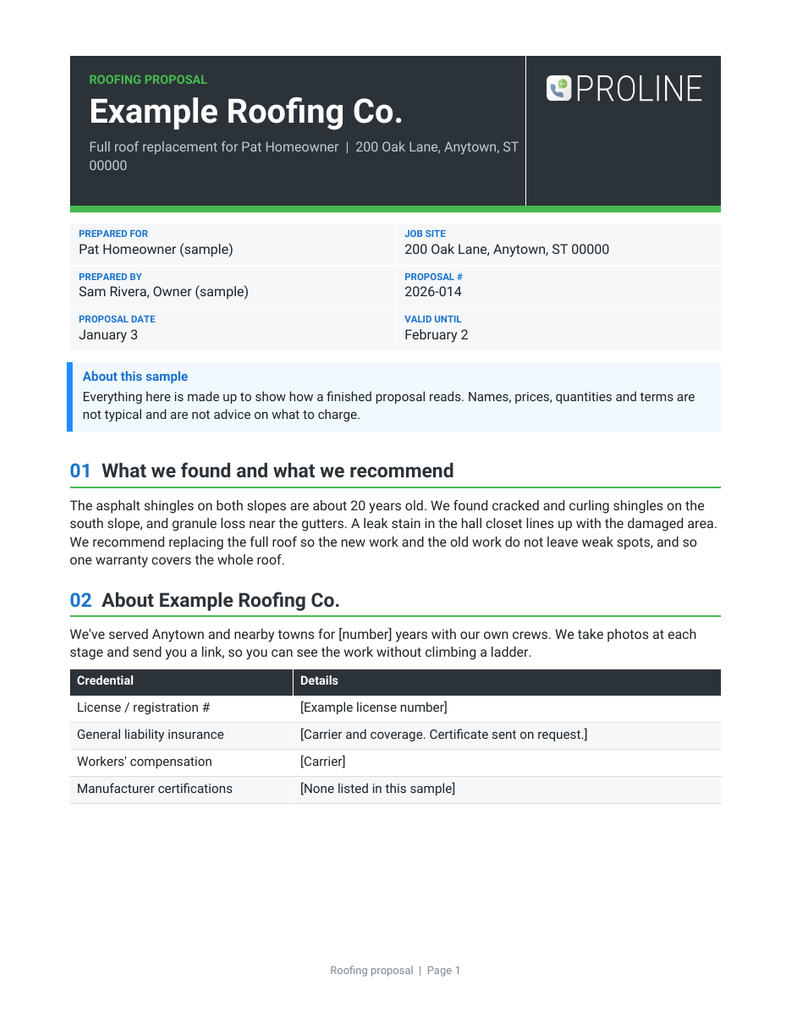
Picture two proposals for the same roof. The first is a one-page quote with a number at the bottom: “Roof replacement, $15,000.” The second is six pages. It says what’s wrong with the roof now, lists each step of the work, names the shingle and the color, shows when the crew starts, and spells out what happens if rotted wood turns up. The homeowner is going to compare them side by side at the kitchen table. Which one feels safer to sign?
A good roofing proposal explains the problem, the plan, the price, the schedule and the rules for changes, in plain words, on pages a homeowner can finish in ten minutes. That’s easier to do when you start from a solid layout, so this page gives you one.
This page is a free download with a guide attached. You get two Word files: a blank roofing proposal template (roofing-proposal-template.docx) with nine sections you can fill in, and a completed example (roofing-proposal-completed-example.docx) for a made-up $15,000, 28-square roof replacement. The names, prices and terms in the example are made up for teaching. They aren’t typical prices or advice on what to charge.
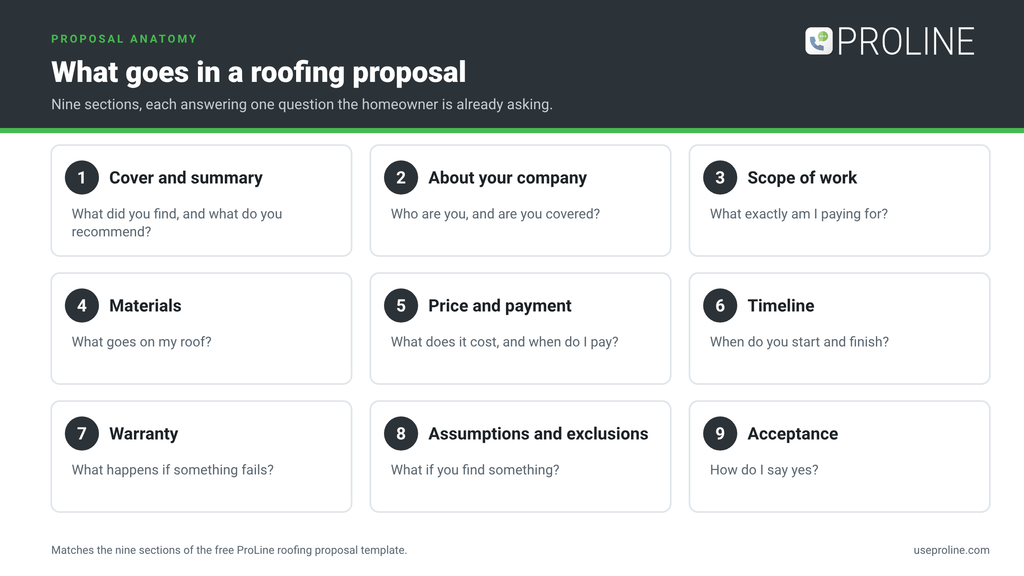
| Section | What the homeowner is asking | What to put there | Example from the filled-out proposal | Common mistake |
|---|---|---|---|---|
| 1. Cover and summary | What’s wrong, and what do you recommend? | Job details, validity date, and 2 to 4 plain sentences | Shingles are about 20 years old, with cracking on the south slope. We recommend a full replacement. | Starting with your company history |
| 2. About your company | Who are you? | Years, areas served, crews, credentials | Own crews, photos at each stage | A long brag page |
| 3. Scope of work | What exactly am I paying for? | Each step, from protection to cleanup | Tear-off, deck check, underlayment, flashing, shingles, vent, cleanup | Writing “complete roof system” and nothing else |
| 4. Materials | What will be on my roof? | Brand, product line, color, quantity | 28 squares of architectural shingles, Weathered Gray | Leaving brand off |
| 5. Price and payment | What does it cost and when do I pay? | Itemized price, options, payment schedule | Line items from a price list, $15,000 total; 30% / 40% / 30% | Hiding the payment terms |
| 6. Timeline | When will you start and finish? | Key dates and weather note | Start about 2 weeks after signing, 2 days on site | No dates at all |
| 7. Warranty | What happens if something fails? | Workmanship and manufacturer coverage, in plain words | Length and what’s covered | Vague promises |
| 8. Assumptions and exclusions | What if you find something? | Hidden damage rate, what’s not included, permits | Extra decking at $85 per sheet with written approval | Surprises added later |
| 9. Acceptance | How do I say yes? | Signature lines and what signing means | Homeowner and company signatures | No clear next step |
What a weak roofing proposal looks like
Most weak proposals have the same problem. They’re written for the roofer, not the buyer. They use words like “complete tear-off and re-roof, per code,” which sound complete but tell the homeowner nothing. They leave out the material brand, the timeline, the rules for extra work and what’s not included. That’s a lot of blanks for a person who’s about to spend thousands of dollars.
Blanks get filled in by worry. A homeowner who can’t tell what’s included will assume the other quote includes more. They’ll call the cheaper roofer to ask. Or they’ll wait, which is the same as saying no. Even when you win the job, the blanks come back later, as arguments about what was promised and what costs extra.
What a good roofing proposal does
A good proposal answers the questions before they’re asked. It shows you looked at the roof, it says what you’ll do in the order you’ll do it, and it makes the price easy to understand. It also says what you won’t do, which is just as important.
It reads in a few minutes. Short sentences, plain words, and a clear order. The homeowner should be able to say after reading it: “I know what they found, I know what they’ll do, I know what I’ll pay and when, and I know what happens if something goes wrong.” That feeling of clarity is part of what the homeowner is buying.
How to write a roofing proposal, section by section
1. Cover and summary
Put the job details at the top: the homeowner’s name, the address, who prepared it, the date, and how long the proposal is good for. A validity date matters because material prices and your schedule change. Then write two to four sentences in plain words about what you found and what you recommend. In the filled-out example, that’s the age of the shingles, the cracking on the south slope, and the recommendation for a full replacement. Write it like you’d explain it standing in the driveway.
2. About your company
Keep this short. Two or three sentences on how long you’ve been in business, where you work, whether you use your own crews or subcontractors, and one thing you do differently. If your state requires a license or registration number, list it. Add your insurance information and any manufacturer certifications you currently hold, and only list what’s true today. Some homeowners will ask for proof of insurance, so say you’ll send a certificate on request.
3. Scope of work
This is the heart of the proposal. List each step so the homeowner knows what’s included: protecting the landscaping and siding, tear-off, deck inspection, underlayment, flashing and details, roofing material, ventilation and cleanup. Add a short note for each step. For example, under tear-off, “one layer found at the inspection.” Under deck repair, “included up to 2 sheets, more at $85 per sheet with your written approval.”
A step-by-step list also protects you. If a customer later says they thought the chimney flashing was extra, you can point to the line that says it was included.
4. Materials
Name the brand, product line, color and quantity for each item. “Architectural asphalt shingles, Weathered Gray, 28 squares” is clear. “Premium shingles” isn’t. Color is worth getting right on paper, since a color mix-up is one of the more painful disagreements. Note how the homeowner chose it, like “chosen from samples.”
5. Price and payment
Build the price from line items, not from one number per square. Pricing a whole roof at a flat rate per square is an easy way to lose profit, because a steep pitch, a second layer, extra flashing or a lot of cut-up roof all cost more than a simple gable. A price list fixes that. You keep every item you sell (tear-off, underlayment, shingles, flashing, vents, deck repair) with its own unit price, and the proposal adds up the lines the job needs. The completed example does this: eight line items add up to $15,000, and an optional impact-rated shingle upgrade adds $1,800 as its own line.
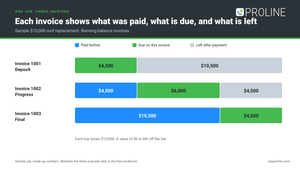
The blank template has the same line-item table, so you can fill it from your own price list. If you keep your price list in a spreadsheet, put one row per item with a unit and a unit price, and copy the rows you need into each proposal. Quantities come from your measurements. Then show the payment schedule: when each payment is due, the percent of the total, and the dollar amount. The sample uses 30% on signing, 40% when materials are delivered and tear-off starts, and 30% when the work is done and the walkthrough is complete. A deposit is optional, and some roofers skip it. If you do, delete that row.
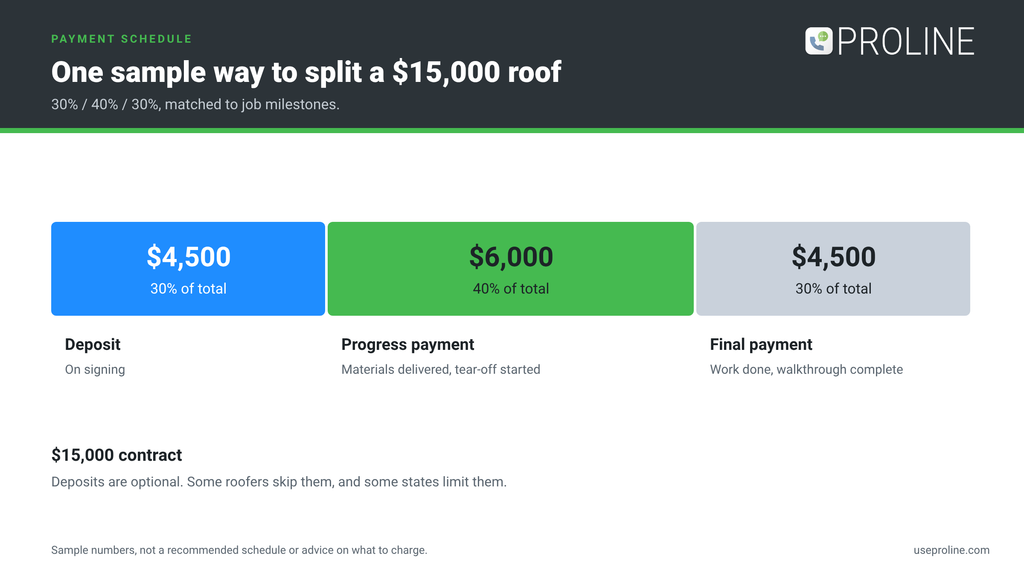
Those percentages are only an example. The right schedule depends on your costs and your state’s rules, and some states limit how much you can collect up front on home improvement work. Check the rules where you work. If you’d like to see how those three payments turn into invoices, see our free roofing invoice template.
State your accepted payment methods too. If you charge a card fee or offer a cash discount, say so here, and only if it’s allowed where you work. Rules on this vary, so ask your attorney or payment provider.
6. Timeline
Give the homeowner a few dates they can plan around: when you’ll order materials, when the crew will start, how many days the job should take and when you’ll do the final walkthrough. Say “weather permitting” and say you’ll tell them as soon as the schedule moves. Warning people ahead of time makes a delay easier to explain.
7. Warranty
Write what’s covered, for how long, and what the homeowner needs to do. Separate your workmanship warranty from the manufacturer’s warranty, because they come from different companies and cover different things. If the manufacturer warranty needs to be registered, say who does that. Avoid broad promises like “lifetime guarantee” unless the written terms really support them.
8. Assumptions, exclusions and change orders
This section prevents most arguments. Say what happens if you find hidden damage under the old roof, like rotted decking. A fair way to write it: “We’ll take photos, send you the price, and wait for your written approval before doing extra work.” List what’s not included, like gutters, painting, interior repairs or skylights. Say who handles permits and who pays for them. And add your weather language.
The FTC gives homeowners the same advice: a written estimate should describe the work, the materials, the completion date and the price. Its page on avoiding a home improvement scam also says a contract signed at home should include a written notice of the right to cancel within three business days.
If your attorney recommends other terms for your state, add them here. This template is a starting point, and the contract language should be reviewed by an attorney who knows your state’s rules.
9. Acceptance
End with a short statement of what signing means: “By signing, the homeowner accepts this proposal and agrees to the scope, price and payment schedule above.” Then give two clear signature lines, one for the homeowner and one for you, each with a date. Don’t leave the next step to guesswork.
Proposal, estimate, and contract: are they the same thing?
People use these words in different ways. An estimate is usually a rough price before the work is fully scoped. A proposal explains the job and the price, and the homeowner may accept it. A contract is a signed agreement that binds both sides. In practice, some roofers use one signed document for both the proposal and the contract. That works as long as the document has the terms your state requires.
The template’s acceptance section is written so the signed proposal can serve as the agreement, but only an attorney can tell you whether it meets the rules where you work. Ask them to look it over once. It’s a small cost compared to the cost of a dispute.
How to use the free files
Start with the filled-out example so you can see where each piece goes. Then open the blank template, replace anything in brackets and delete any section you don’t need. Put your logo in the header, adjust the fonts if you like, and save it as a master copy. For each job, save a new copy with the homeowner’s name in the filename and the proposal number you plan to use.
A few habits make the document better. Use photos from the inspection, because a picture of a cracked shingle beats a paragraph about it. Check every number twice, including the line items, the total, the payment amounts and the quantities. If you want a more polished PDF, you can paste your finished proposal into Claude, ChatGPT or Gemini and ask it to turn it into a branded PDF, then check every number it returns. Have someone else read it once for typos. And send it in a format the homeowner can open on a phone, since many will read it there first.
Six roofing proposal template mistakes that cost you jobs
- Writing for yourself. If a sentence needs a roofer to understand it, rewrite it.
- Leaving out the brand, color or quantity. These are the details people argue about later.
- Hiding the exclusions. If something isn’t included, say it plainly up front.
- Burying the payment schedule. Show when and how much, in a table.
- Sending it late. A good proposal that sits on your desk for a week gives the homeowner time to talk to someone else.
- Making promises you can’t back up, like a firm start date in the rainy season.
- Sending it and going quiet. A short follow-up text a few days later, with a link and an offer to answer questions, keeps the conversation going. Our free text message library has the wording.
When Word and PDFs stop being enough
A Word template is a fine place to start. It gets slow when every proposal has to be built by hand, when prices change, and when you want customers to sign without printing anything. That’s when roofers start looking for software built for quotes.
ProLine’s quoting is built around the price list. Your price list holds every item and service with its own price, unit and quantity rules, and you add those items to quotes, quote templates and invoices. That keeps your pricing consistent, and it gives you a way to price by line item instead of a flat rate per square. You can build quotes from templates, send them to the homeowner, and use the signature page so the customer can accept online. Here’s a demo of Quoting Roofs With ProLine CRM, and you’ll find more on the ProLine YouTube channel.
The pieces also connect. A fully signed quote can feed the invoice, and if your quote template is set up to send a deposit invoice when the quote is signed, ProLine can send it along with the signed copy. If the template is set to create draft material orders, ProLine can add them for your office to review once the quote is fully signed. A Word template can’t carry a quote forward into an invoice and an order. It isn’t for everyone. If you write a few proposals a month and a good Word template does the job, keep using it. If you spend your evenings rebuilding documents, take a look at ProLine’s quoting and see if it fits how you work.
FAQs
What should be in a roofing proposal?
A summary of what you found and what you recommend, your company and credentials, a step-by-step scope of work, the materials by brand, color and quantity, the price and payment schedule, a timeline, warranty details, what’s not included and how extra work is handled, and a place for both sides to sign.
How long should a roofing proposal be?
Long enough to answer the homeowner’s questions and short enough to read in about ten minutes. The sample in this article runs about six pages, mostly tables. Use photos and short sentences, and don’t pad it.
What’s the difference between a roofing estimate and a roofing proposal?
An estimate is usually a rough price given before the work is fully scoped. A proposal lays out the specific scope, materials, price and terms, and the homeowner can accept it. Some roofers use a signed proposal as their contract, but check with an attorney that yours has what your state requires.
Can a roofing proposal also be a contract?
Often it can, once both sides sign it, but whether it meets your state’s rules is a legal question. Ask an attorney who knows your state’s home improvement rules to review your template once.
How do I handle hidden damage in a proposal?
Say how you’ll handle it before the job starts. A common approach is to photograph the damage, send the homeowner the price and get written approval before doing extra work. Some roofers put a per-sheet rate for decking in the proposal, like the $85 in the sample.
How much deposit should I put in a roofing proposal?
It depends on your costs, your contract and your state’s rules. Some states limit deposits on home improvement work. Compare the deposit to the first bills you’ll pay, like materials, to see how much you’d fund yourself.