Your roofing business software should make your company easier to run. But if your team is still chasing leads through texts, searching across different systems for job information, manually reminding reps to follow up, and building reports in spreadsheets, something is off.
That does not mean you bought bad software. Your business may have simply outgrown what worked when you were smaller. You add tools for sales, production, estimates, and accounting, and suddenly you have more technology but less visibility. The problem comes from having software with notable gaps between them.
Your software should improve communication, keep opportunities moving, and show you where revenue is coming from.

The First Warning Sign: Your Team Is Still Doing the Work Manually
Roofing business software comes in several categories, and each one handles a different part of the operation:
- CRM software: Manages leads, sales pipelines, homeowner communication, and follow-up.
- Roof measurement software: Provides measurements, aerial imagery, and property data for estimating.
- Estimating software: Helps you build scopes, calculate costs, and prepare estimates.
- Project management software: Keeps sold jobs organized through production, scheduling, and completion.
- Accounting software: Handles invoices, payments, expenses, payroll, and financial reporting.
The problem starts when your team has to do extra work to move information between these systems. If your salesperson has to copy lead information into multiple platforms, search through personal texts for homeowner conversations, or manually remember when to follow up, your technology stack is adding friction instead of removing it.
That becomes expensive as your company grows because every missed follow-up or delayed response can affect a high-value roofing opportunity.
Your CRM should bring the customer-facing side of the business together. ProLine takes a communication-first approach because better communication strengthens the homeowner relationship, and that relationship helps you sell more jobs: Communication → Relationship → Revenue.
What Software Do Successful Roofing Companies Use to Manage Their Business?
7 Signs Your Roofing Business Software Is Holding You Back
Problem #1: No One Owns New Leads
This is one of the most expensive software problems you can have. You paid for the lead. Someone on your team received it. The homeowner was interested. And then nothing happened. Maybe the salesperson was busy at an inspection. Maybe the lead came in after hours. Maybe the rep intended to call back but forgot. Maybe the homeowner received an estimate and never got another message.
None of those problems look dramatic by themselves. Collectively, they can create a serious leak in your sales pipeline. The solution is not simply telling your team to “follow up more.” You need a system that makes follow-up part of the workflow.
Your roofing business software should make it obvious who needs attention, what has already happened, and what needs to happen next.
That is where automated communication and task management become valuable. Instead of relying on memory, your team can have a defined process for calls, texts, emails, appointments, estimates, and follow-ups.
Problem #2: Your Salespeople Are Using Personal Phones
Your salespeople need to communicate with homeowners. That is not the problem. The problem starts when important customer conversations live exclusively on individual devices.
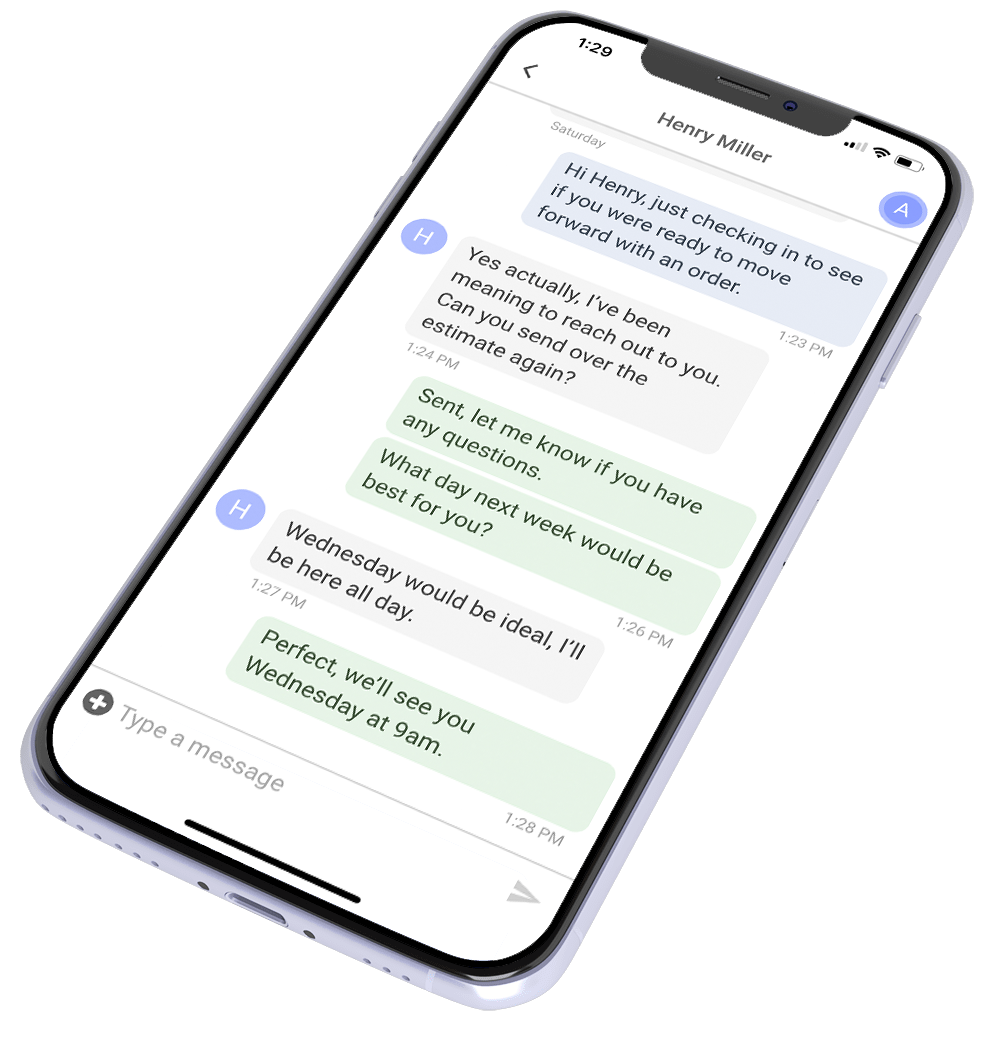
A salesperson’s phone may contain texts, photos, appointment details, questions, and other information that the rest of the company cannot easily access. If that salesperson leaves, goes on vacation, or simply misses a message, the relationship can become difficult for someone else to pick up. A communication-first CRM helps sales reps build relationships with homeowners while giving managers visibility into what’s being said.
That means the company can maintain context around the homeowner instead of letting important information disappear into individual conversations. It gives managers better visibility without requiring them to constantly interrupt salespeople for updates.
Problem #3: Your Software Creates More Data Entry
Software is supposed to reduce administrative work. Sometimes it does the opposite. If your team has to enter the same homeowner information into multiple systems, manually copy job details between platforms, and update several records whenever something changes, your technology stack is creating work. And people can tend to stop doing work that feels repetitive.
That creates another problem: incomplete data. The sales rep updates one system but forgets another. Production has an old phone number. Management sees a stale pipeline. Reporting becomes unreliable because the underlying information is inconsistent.
Integration can help, but the goal should not be “more integrations” simply for the sake of having them. Your systems need to reduce friction in the actual workflow your team follows.
Problem #4: Your Managers Cannot See What Is Actually Happening
Growth creates a visibility problem. When you have a small roofing company, you can often ask everyone what is happening. You know which jobs are coming up, which homeowners are waiting, and which salesperson is struggling. That does not scale. Eventually, you need reporting that answers questions such as:
- How many opportunities are currently open?
- How quickly are new leads being contacted?
- How many estimates are sitting without follow-up?
- Which salespeople are converting opportunities?
- Where are jobs getting stuck?
- Which marketing sources are producing revenue?
- How much business is currently in the pipeline?
If your team has to build those answers manually every week, your reporting system is consuming management time instead of giving it back. ProLine’s reporting tools are designed to give roofing companies visibility into the activity and outcomes happening inside the sales process.
Problem #5: Your Software Measures Activity Instead of Revenue
Your software might tell you that you generated 500 leads last month. That sounds impressive. But how many became inspections? How many received estimates? How many signed contracts? How much revenue did they generate?
A roofing company’s economics make that last one especially important. You are not building a subscription business where the same customer pays you every month. You need to continually acquire new customers, and the profit from each job has to support future acquisition.
That makes customer acquisition efficiency extremely important. A marketing source that produces 100 cheap leads may be less valuable than one that produces 30 qualified opportunities and 15 sold jobs. Your roofing business software should help you follow that journey.
Problem #6: Your Follow-Up Process Depends on Memory
There is nothing wrong with having great salespeople, of course. But there is something wrong with building your sales process around the assumption that great salespeople never forget anything. They do. Your reps are driving between inspections, talking to homeowners, dealing with crews, answering questions, preparing estimates, and trying to close jobs. Expecting them to remember every follow-up without a system is unrealistic.
A defined follow-up process creates consistency. For example, after an estimate is delivered, your system can make the next communication visible. If the homeowner does not respond, the opportunity should not simply disappear from the pipeline.
That is one of the places where automation is genuinely useful. It does not replace the salesperson. It gives the salesperson a consistent process to follow.
Problem #7: Your Homeowner Experience Changes Depending on Who Answers
Imagine two homeowners contacting the same roofing company.
- The first gets a response within minutes, receives clear information, knows what will happen next, and gets consistent updates.
- The second waits several hours, has to repeat information to different employees, and does not know when the inspection will happen.
Same company. Same service. A completely different experience. Your software plays a role in determining which experience your customers receive.
Communication is part of perceived value. When homeowners are making a major purchase, clear and consistent communication reduces uncertainty. It shows them that your company is organized and that someone is paying attention.
That is why ProLine’s communication-first positioning matters. The CRM is built around the idea that better communication strengthens the relationship, and stronger relationships help you win more jobs.

How to Know When It Is Time to Switch
You do not need to switch software because your team has one complaint. You should evaluate the situation when the same operational problems keep appearing, and your current system can’t solve them without workarounds. Look for patterns:
- Your team maintains spreadsheets outside the CRM.
- Salespeople rely heavily on personal texting.
- Managers cannot easily see pipeline health.
- Follow-up depends on individual memory.
- Your team enters the same information multiple times.
- You cannot connect lead sources to revenue.
- Important homeowner conversations are difficult to find.
- Adding new employees requires extensive manual training.
- Your software creates more administrative work as you grow.
If several of these sound familiar, the software may have become a constraint. Before switching, map your current workflow from lead to sold job. Identify where information disappears, where communication slows down, and where employees are creating manual workarounds. Then evaluate software against those problems.
Do not start with the question, “Which CRM has the most features?” Start with, “Which system will help us communicate better and run the business we actually have?”

Why You Need a Communication-First Roofing CRM
Your roofing business software should make growth easier, not force your team to create workarounds just to get through the day. If leads are slipping through the cracks, follow-up depends on memory, customer conversations live on personal phones, and management cannot connect marketing activity to revenue, the problem may not be your people. It may be the system they are being asked to work inside.
ProLine is a communication-first CRM built around the simple idea that Communication → Relationship → Revenue.
See how ProLine can help you replace software friction with a system built for roofing.
FAQs
What is roofing business software?
Roofing business software is technology designed to help contractors manage functions such as leads, sales, customer communication, projects, reporting, and other business operations. A roofing CRM specifically focuses on managing customer relationships and the sales process.
How do I know if my roofing software is holding my company back?
Look for repeated manual work, missed follow-ups, disconnected customer information, poor reporting, duplicate data entry, and heavy reliance on spreadsheets or personal phones. If your team is building workarounds around the software, it may no longer fit your business.
Should roofing companies use a CRM?
For most growing roofing companies, a CRM can help organize customer information, manage opportunities, track communication, automate follow-up, and understand sales performance. Its value depends on whether the system fits your workflow and your team uses it consistently.
What features should roofing business software have?
Look for lead management, pipeline tracking, communication tools, follow-up automation, reporting, mobile access, integrations, customer history, and scalable management features. More importantly, those features should work together rather than operate as isolated tools.