If you want to know how to grow a roofing business past $10 million, doing more of what got you to $3 million or $5 million isn’t enough. At some point, the owner can’t be the person who approves every estimate, solves every production problem, checks every salesperson’s pipeline, and remembers which homeowner needs a call. That’s the ceiling.
The companies that break through it build systems that make good decisions repeatable. Sales can’t depend on one rainmaker. Production can’t depend on the owner knowing every crew. Follow-up can’t depend on memory. Reporting can’t depend on a spreadsheet someone updates Friday afternoon. The shift is simple to describe but harder to execute: you have to stop building a bigger roofing hustle and start building a roofing company that can operate without you touching everything.

Why the $10M Mark Exposes an Owner-Driven Business
The $10 million number isn’t a magic threshold where everything suddenly changes. It’s a useful point where the limits of an owner-driven business get much harder to hide.
Roofing Contractor’s 2025 State of the Industry survey of its subscribers found that median annual revenue among respondents was between $5 million and $9.9 million. Because the survey went to magazine subscribers, it may lean toward larger, more established companies than the industry as a whole. A $10 million company would sit just above that median.
At this level, small inefficiencies stop being small. If one salesperson forgets a follow-up, that’s one missed opportunity. If ten salespeople work without a consistent process, you have a systemic problem. If production communication breaks down on one project, you fix a job. If it happens across dozens of projects, you have an operating model that needs to change. The goal is a company that depends less on individual heroics.
Stop Asking, “Who Handles This?” and Start Asking, “What Is the Process?”
This is the first major shift. In a smaller roofing company, you might solve problems by assigning them to a person. John handles estimates. Sarah follows up with homeowners. Mike knows which crew is going where. That works until John, Sarah, or Mike is unavailable. A scalable company defines the process first and assigns ownership second. For every major workflow, you should be able to answer these questions:
- What triggers the process?
- Who owns the next step?
- What information do they need?
- What happens if the customer doesn’t respond?
- What happens if the task is late?
- Where is the status recorded?
- How does management know whether it worked?
That’s the difference between having employees and having an operating system. ProLine helps make these workflows visible inside the CRM through job stages, tasks, automations, communication history, and reporting. The point is to stop important work from living inside someone’s head, without adding another layer of admin.
Your Sales Process Has to Become Repeatable
It’s hard to grow a roofing business past $10 million if your sales process only works when your best salesperson is involved. That doesn’t mean every salesperson needs to sound identical. You still want individual personalities. You do need a consistent customer journey. A roofing sales system should define what happens from: Lead → Contact → Inspection → Estimate → Follow-Up → Contract → Handoff
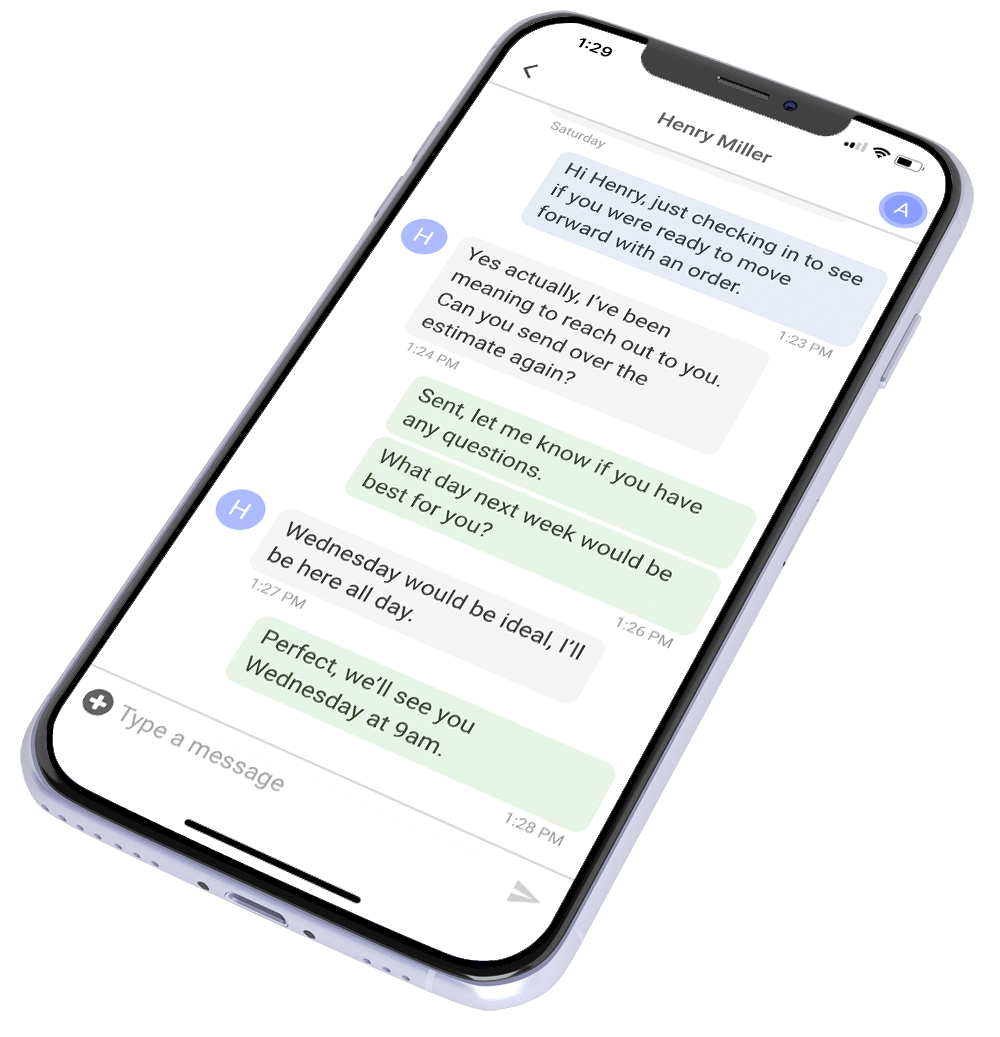
The important word is follow-up. A homeowner who receives an estimate hasn’t necessarily rejected you. They may be comparing contractors, waiting for a spouse, dealing with insurance, reviewing financing, or simply not ready to make a decision.
That opportunity shouldn’t disappear because the salesperson got busy with newer leads. This is where a communication-first CRM becomes useful. Your salespeople can spend more time talking to homeowners instead of trying to remember which homeowner they forgot to call.
ProLine’s approach is built around that idea. Communication keeps the relationship moving, so it belongs inside the sales process: Communication → Relationship → Revenue.
How Steadfast Roofing Grew from $3M to $17.3M Without Chasing Storm Damage: Jon Starry
Build a Management Layer Between You and the Work
If every problem still reaches the owner, the company hasn’t really scaled. You need people who own outcomes. That might mean a sales manager owns sales performance, a production manager owns job flow, an office manager owns administrative processes, and a finance leader owns cash and reporting. The exact structure depends on your company, but the principle stays the same.
You need a layer of management that can solve problems without forwarding every decision to you. This is also where delegation becomes different from simply giving someone a task. Giving an employee a task sounds like, “Call these five homeowners.” Delegating an outcome sounds like, “You own follow-up performance for this pipeline.” The second creates accountability. The first creates another person waiting for instructions.
Your Reporting Has to Tell You Where the Business Is Breaking
Once you’re managing a larger roofing company, your gut can become less useful. You can’t personally observe everything. That means your reporting needs to answer questions such as:
- Which marketing sources are producing opportunities?
- How quickly are new leads being contacted?
- How many opportunities are becoming contracts?
- Which estimates are sitting without follow-up?
- Where are jobs getting stuck?
- Which projects are producing healthy margins?
- How much money is currently outstanding?
You don’t need a dashboard filled with dozens of metrics. You need the numbers that tell you what requires attention. ProLine’s reporting tools give roofing companies visibility into sales performance, activity, marketing sources, production, profitability, and cash flow. That means you can look at what’s happening across the business without asking every manager to build a separate report.
The Owner Has to Stop Being the Company’s Memory
This may be the hardest change. You know where everything is because you’ve been involved in everything.
You know which homeowner needs a callback. You know which salesperson is struggling. You know which crew is reliable. You know which jobs have a weird scope issue. You know which payment hasn’t arrived. That knowledge feels like an advantage.
It becomes a bottleneck when nobody else can access it. The information needs to move from your memory into the system.
Customer conversations should live with the customer record. Tasks should live in the workflow. Job status should be visible. Important notes should be documented. Decisions that affect future work should become part of the process. Then you can finally step away without the business becoming blind.
That’s one of the core ideas behind ProLine’s communication-first CRM. The relationship should belong to the company, not one salesperson’s phone.
Hiring More People Won’t Fix a Broken System
Growth usually creates a hiring temptation. Sales are up, so hire more salespeople. Jobs are piling up, so hire more production staff. The office is overwhelmed, so add another administrator. Sometimes that’s exactly what you need. But adding people to a broken process can simply create more people doing the same inefficient work.
The construction labor market makes that especially important. In a 2026 survey by the Associated General Contractors of America and NCCER, released in September 2026, 88% of construction firms with craft openings said those positions were as hard or harder to fill than a year earlier. Among firms with salaried openings, 87% reported the same.
So think about productivity before headcount. Can the existing team spend less time entering information? Can follow-up happen automatically? Can managers see problems earlier? Can new employees understand the workflow without asking someone how everything works? Technology can’t replace skilled people. It can make the people you already hired more effective. Roofing Contractor has a list of ways to use AI in your roofing business. Whatever you try, keep a person reviewing the work.

Standardize the Customer Experience
Scaling creates another risk: the homeowner experience becomes inconsistent. One salesperson communicates constantly. Another disappears after the estimate. One production manager sends updates. Another only responds when the homeowner calls.
From the customer’s perspective, those are different companies. That matters because roofing is a high-ticket purchase that homeowners don’t make often. You usually don’t have years of customer history to fall back on. The homeowner is deciding whether to trust you with a major purchase based partly on how you communicate during the short period you have together.
This is where perceived value becomes important. You don’t create value only through shingles, labor, or workmanship. You create it through the experience around the work. Clear expectations. Fast answers. Useful education. Consistent updates. Professional follow-through.
When two roofing companies offer similar scopes at similar prices, the homeowner’s experience with your company becomes part of what they’re buying. That’s how communication can become a business advantage instead of just a customer-service function.
Automate the Repetitive Work, Not the Relationship
Automation becomes more valuable as you grow, but there’s a right way to use it. Don’t automate everything just because your software allows it. Automate the repetitive actions that should happen consistently:
- Lead acknowledgment
- Appointment confirmations
- Estimate follow-ups
- Internal reminders
- Status notifications
- Payment reminders
- Review requests
- Routine customer updates
Keep the important relationship conversations human. A homeowner with a question about their roof doesn’t need to feel like they’re talking to a machine. Your system should make it easier for your team to respond, not make the response feel less personal. That distinction is central to ProLine’s approach to roofing automation. The technology should handle repetitive work while your team focuses on the communication that builds the relationship.

Build the Business So You Can Leave for a Week
Here’s a practical test. Take a week away. Not a week where you answer 40 texts from the airport. A real week where your managers run the company and you stay out of the weeds. What breaks?
- If sales stop because you’re the only person who knows the pipeline, you have a sales-system problem.
- If production slows because you approve every decision, you have a delegation problem.
- If homeowners can’t get answers without you, you have a communication problem.
- If nobody can tell you how the company performed while you were gone, you have a reporting problem.
That exercise can show you what to systemize next. And there’s a bigger benefit. You stop building a company where growth simply gives you more work.
ProLine gives you the communication-first CRM infrastructure to connect leads, follow-up, sales, jobs, and reporting in one system, so you can sell more jobs, build a company that doesn’t depend on your memory, and make it home for dinner. See how ProLine can help you build the system behind your next stage of growth.
FAQs
How do I grow a roofing business past $10 million?
Build repeatable systems for sales, communication, production, hiring, delegation, financial management, and reporting. The company gets harder to scale when every decision still depends on the owner.
What’s a common obstacle to scaling a roofing company?
Owner dependence is a major operational constraint. If sales, production, customer communication, or important decisions can’t happen without you, the business has a capacity limit tied to your personal availability.
How important is a CRM when scaling a roofing business?
A CRM can centralize customer information, communication, pipeline activity, follow-up, and reporting. The important part is making it part of the company’s daily workflow instead of treating it as a database.
Should I hire more employees to grow my roofing company?
More employees may be necessary as volume increases, but hiring into inefficient processes can add cost without solving the underlying problem. Define the workflow first, then decide where additional people are needed.
How can I stop being involved in every roofing job?
Document recurring processes, delegate outcomes to managers, centralize customer and job information, automate repetitive communication, and use reporting to manage by exception. The goal is to make the system visible enough that you don’t need to personally monitor every job.