
Most roofing companies using the roof franchise CRM don’t have a technology problem. They have a technology sprawl problem.
Over time, new tools get added to solve specific issues. One platform handles leads. Another manages scheduling. A third stores documents. A fourth tracks supplements. Then there are separate communication apps, reporting dashboards, invoicing tools, and project management systems layered on top. Each tool may solve an individual problem, but together they often create a bigger one.
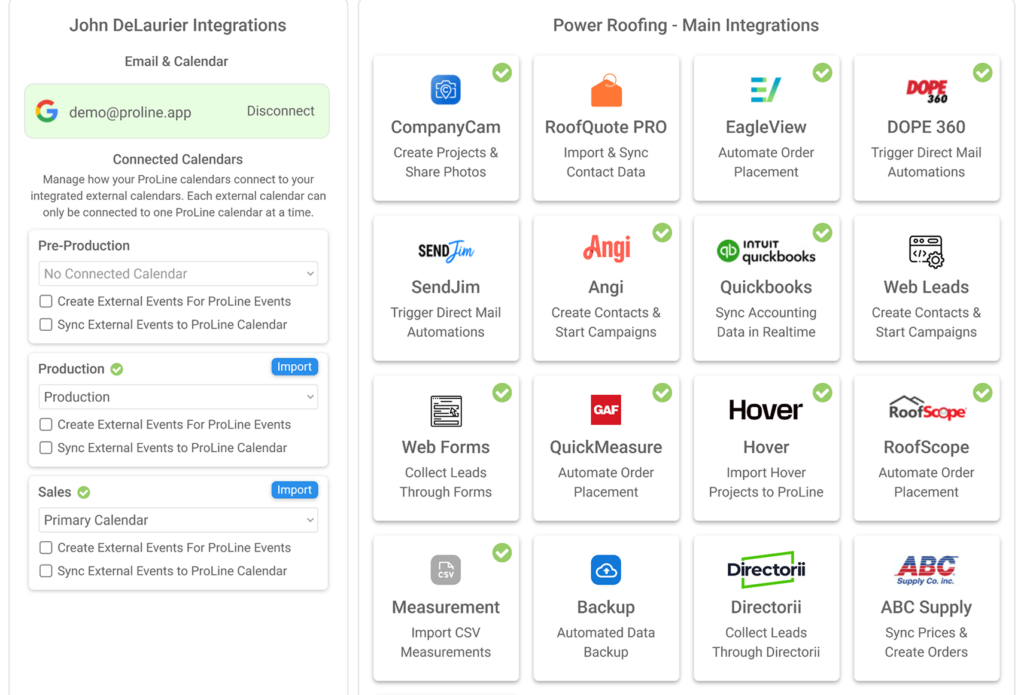
Why Roofing Tech Stacks Become So Complicated
The rise of AI is affecting the roofing industry as well. Data shows that now 12% of employees in all sectors use AI every day. But this tech adoption can easily become a problem when everything is complicated & fragmented. Truth be told, most roofing companies don’t intentionally build complicated systems.
The process usually happens gradually. A company adopts one platform for lead management. Then they discover it doesn’t handle production tracking well, so they add another solution.
Later, they need reporting capabilities, so they purchase another tool. Eventually, they need supplement management, internal communication, digital forms, and customer follow-up systems.
Before long, employees are logging into six or seven different platforms every day. The challenge is that every additional tool introduces another layer of complexity.
- Information has to move between systems.
- Employees need training on multiple platforms.
- Managers have to verify data accuracy across separate databases.
- Reporting becomes fragmented because no single system contains the complete picture.
Research estimates that employees switch between applications and digital tools hundreds of times per day, creating significant productivity losses through context switching and fragmented workflows. This “online fatigue” makes them lose almost one hour a week of work productivity. In roofing operations, those interruptions don’t just waste time. They create communication gaps, missed follow-ups, and delayed decisions that directly affect profitability.
The Hidden Cost of Software Fragmentation
The monthly subscription fees are usually the most visible cost of a fragmented tech stack. The hidden costs are far larger, despite what the promoters of this tech trend like to admit.
When information lives in multiple systems, your team spends valuable time searching for answers instead of executing work. A production manager needs to check one platform for schedules, another for customer communication, and another for job documentation. A salesperson may need to update the same information in multiple places. Those small inefficiencies add up quickly.
Consider what happens when a customer calls asking about project status. If the answer requires opening three different systems and contacting two team members, that delay impacts the customer experience. It also consumes valuable labor hours that could have been spent moving jobs forward. The larger the company becomes, the more expensive these inefficiencies become.
Why Franchise Models Suffer More Than Independent Roofing Companies
Technology fragmentation affects every roofing company, but franchise operations face additional challenges. Franchise growth depends on consistency. Processes must be repeatable across teams, locations, and markets. Every office should be working from the same playbook.
When different locations rely on different combinations of software, standardization becomes difficult. Some locations may track jobs one way while others follow different procedures. Reporting becomes inconsistent. Leadership loses visibility into operational performance because data isn’t structured uniformly.
This creates a situation where scaling becomes harder as the organization grows. A consolidated roof franchise CRM helps establish a common operational language. Everyone follows the same workflows, updates the same records, and measures performance using the same data. That consistency becomes increasingly valuable as additional locations come online.

How Consolidation Improves Communication
Communication is one of the first areas to improve when systems are consolidated, especially when it comes to roofing automation technologies.
In many roofing companies, communication is scattered across emails, text messages, phone calls, project management tools, and CRM notes. Important information gets buried because there is no centralized place to track conversations.
This creates avoidable problems. Production teams may miss updates from sales. Customer service representatives may not see conversations that happened in the field. Managers may spend hours trying to piece together the history of a job.
When communication lives inside a centralized CRM environment, everyone operates from the same information. Instead of searching for answers, employees can immediately access job history, customer interactions, production updates, and internal notes.
This is one reason communication-first platforms like ProLine have gained traction among roofing contractors. The goal isn’t simply storing information. The goal is to make sure the right people have access to the right information at the right time.
Better Data Leads to Better Decisions
Most business decisions are only as good as the data behind them. When information is fragmented across multiple systems, reporting accuracy becomes a challenge. Different platforms may contain conflicting numbers. Updates may not synchronize correctly. Teams may interpret data differently because they are looking at different sources.
A consolidated roof franchise CRM creates a single source of truth. Instead of asking which report is accurate, leadership can focus on what the data is telling them. This improves visibility into:
- Lead conversion rates
- Sales performance
- Job profitability
- Production efficiency
- Supplement recovery
- Customer satisfaction trends
- Revenue forecasting
How Consolidation Helps You Sell More Jobs
One of the biggest misconceptions about software consolidation is that it’s purely an operational improvement. In reality, it often has a direct impact on revenue growth.
When sales teams operate inside a unified system, lead management becomes more consistent. Follow-ups are easier to track. Customer communication becomes more organized. Pipeline visibility improves.
Research consistently shows that companies with strong CRM adoption achieve higher sales productivity and stronger customer retention compared to organizations with fragmented customer data. For roofing contractors, this translates into practical advantages.
Leads are less likely to fall through the cracks. Follow-up schedules become more consistent. Managers gain visibility into sales activity without needing separate reports from multiple systems. Simply put, consolidated systems often help contractors sell more jobs because they eliminate operational friction.
The Operational Benefits of a Single System
Beyond sales and communication, consolidation creates significant operational advantages. A centralized roof franchise CRM allows teams to manage:
- Lead Tracking: Every prospect enters the same pipeline, creating consistent processes across locations and sales representatives.
- Job Management: Production teams can track progress without switching between multiple platforms.
- Customer Communication: Conversations remain attached to job records, improving visibility and accountability.
- Reporting: Leadership gains access to unified performance metrics across the entire organization.
- Team Accountability: Task ownership becomes clearer because responsibilities are tracked within a single system.
Signs Your Tech Stack Has Become Too Complex
Many roofing companies don’t realize they have a technology problem until the symptoms become obvious. Common warning signs include:
- Employees frequently ask where information is stored
- Duplicate data entry across multiple systems
- Inconsistent reporting numbers
- Missed follow-ups or communication breakdowns
- Long onboarding times for new employees
- Difficulty generating accurate company-wide reports
- Team members maintain their own spreadsheets outside official systems
Consolidation Doesn’t Mean Eliminating Every Tool
It’s important to clarify that consolidation doesn’t mean forcing every function into a single platform regardless of fit. Specialized tools still have value. For example, measurement solutions, accounting platforms, and certain industry-specific applications may continue playing important roles within your operation.
The goal is not software minimalism. The goal is reducing unnecessary overlap while ensuring your core workflows live inside a centralized operational system.
Your roof franchise CRM should serve as the foundation that connects people, jobs, communication, and reporting. Supporting tools should enhance that ecosystem rather than create separate information silos.
What to Look for in a Consolidated Roof Franchise CRM
If you’re evaluating ways to simplify your tech stack, focus on platforms that strengthen operational alignment. Look for systems that provide:
- Centralized communication
- Lead and pipeline management
- Job tracking
- Reporting dashboards
- Mobile accessibility
- Workflow automation
- Franchise-level visibility
- Team accountability features
Most importantly, evaluate whether the platform reduces the number of systems your team must touch each day. Every eliminated login represents reduced complexity and increased efficiency.
Consolidate Your Tech Stack by Adopting a Single CRM
Consolidating your roof franchise CRM tech stack allows your team to spend less time managing software and more time serving customers, selling jobs, and executing projects. It creates a shared source of truth, improves communication, strengthens accountability, and helps leadership make better decisions using accurate data.
If you’re ready to simplify operations and build a more scalable roofing business, ProLine provides a communication-first CRM designed specifically for roofing contractors. By bringing customer communication, job management, reporting, and team visibility into one system, ProLine helps you sell more jobs, streamline operations, and spend less time chasing information… so you can make it home for dinner.
FAQs
What does it mean to consolidate a roof franchise CRM tech stack?
Consolidation means reducing the number of disconnected software tools your company uses and centralizing key workflows inside a unified CRM platform.
Why do roofing companies end up with complicated tech stacks?
Most companies add software gradually to solve individual problems. Over time, this creates overlapping systems that increase complexity and reduce operational efficiency.
How does software consolidation improve communication?
A centralized CRM keeps customer interactions, job updates, internal notes, and workflow information in one place, making it easier for teams to stay aligned.
Can consolidating software help increase sales?
Yes. Consolidated systems improve lead management, follow-up consistency, pipeline visibility, and customer communication, all of which contribute to stronger sales performance.
What should a roof franchise CRM include?
A strong roof franchise CRM should support lead tracking, job management, communication, reporting, workflow automation, and franchise-wide visibility while reducing the need for multiple disconnected tools.