The easiest way to supercharge your profit? Lock in your roofing business market positioning.
The best roofing marketing advice anyone will ever give you is this: get your position right.
Why? Because without the right market positioning for your roofing business, every dollar you spend on marketing gets flushed. Homeowners won’t understand why they should hire you. Your offers won’t make sense. Competitors will steal jobs right out from under you, and you’ll stand there wondering what happened.
This article breaks down what market positioning is, why it controls your success, and how to build a position that makes homeowners think, “That’s the roofer for me.”

What is Roofing Business Market Positioning?
Ever heard of the Manitou Incline? It’s a brutal hiking trail in Manitou Springs, Colorado, made out of old railroad ties. It climbs over 2,700 steps with an average slope of 45 degrees. The whole trail gains more than 2,000 feet of elevation in less than a mile — and it starts at over 6,000 feet above sea level.
In other words, it’s a leg destroyer.
One day, Ian — head of content here at ProLine — decided to hike the Manitou Incline. It went exactly how you’d expect. When he finally crawled back into the parking lot, something caught his eye: two kids with a lemonade stand.
Ian doesn’t even remember the price. Could’ve been $5 a cup, maybe more. What he does remember is thinking, “I’d pay anything for lemonade right now.”
That’s positioning.
Those kids could’ve set up on a random street corner, hoping a few people might walk by. Instead, they planted themselves exactly where sweaty, exhausted hikers would stumble down — the exact people who would crave what they were selling.
You want to do the exact same thing with your roofing business. Not by setting up a lemonade stand, but by positioning yourself in the minds of homeowners so you’re the obvious choice the second they realize they need a roof.
How to Compare Your Roofing Business to Competitors
The easiest way to think about market positioning is this:
How do you compare to your competitors — in the mind of the homeowner?
When a homeowner mentions your name in the same breath as your competitor, what do they say? Do they think you’re the high-end roofer who does it right the first time? The budget guy who’s fast and cheap? The one who never calls back?
More importantly, what are you doing right now to influence what they say?
Even better — what do you want them to say?
If you don’t know the answer to those questions, don’t sweat it. There’s a simple way to find out where you stand — and where you could stand — compared to every other roofer in your market.
The Market Position Map
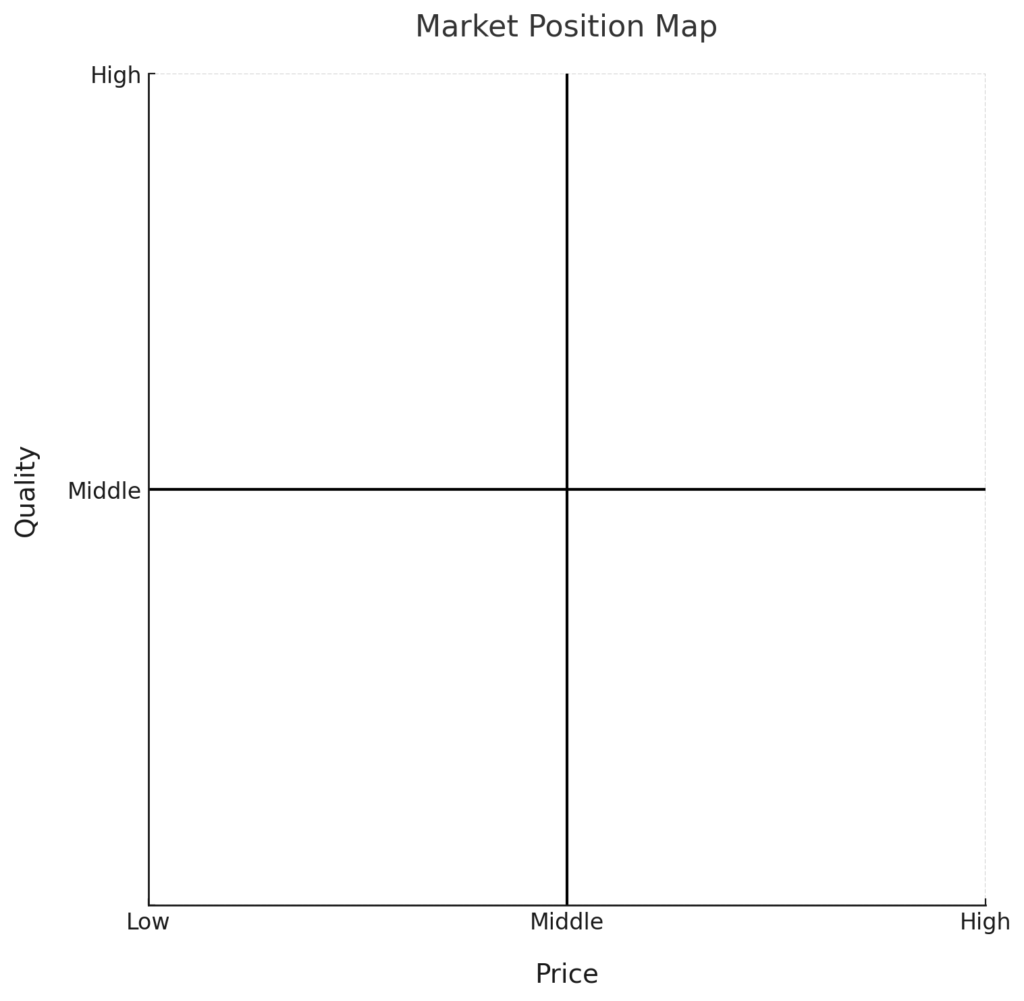
Marketing consultants have been using this tool for decades because it works. It’s called a Market Position Map, sometimes called a Price-Quality Matrix. It’s dead simple, and you can sketch it out in two minutes.
Here’s how it works:
- Draw a big plus sign, so you have four boxes — one in each corner.
- Label the left side “Low Price” and the right side “High Price.”
- Label the bottom “Low Quality” and the top “High Quality.”
That’s it — now you’ve got a map.
You can also map it out like a matrix. That looks like this…
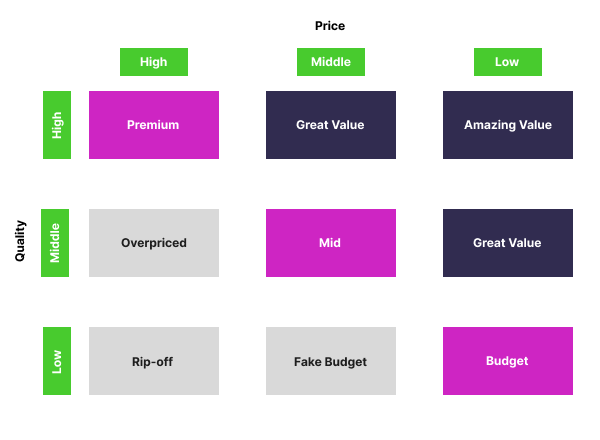
It’s a simple way to plot where you stand — and where your competitors stand — based on:
- How much homeowners pay (price)
- How much value they get (quality)
Take a few minutes to plot your own company and your top competitors on the map. Be honest. If you charge top dollar and offer top service, you belong in the top-right corner. If you’re the budget option with fast and basic work, you’re down in the bottom-left.
Two Winning Positions (and One That’ll Bury You)
In general, successful roofers land in one of two sweet spots:
- Premium Roofing: High quality at a high price — luxury materials, flawless installs, white-glove service, long warranties.
- Value Roofing: High quality at a fair price — great work, fair rates, high volume, happy customers.
What you want to avoid like the plague is charging high prices for low quality work. That’s where reputations go to die.
Now, you can try the “low price, low quality” approach — but unless you plan to become the Walmart of roofing and crank out insane volume, it’s a tough way to make real money.
Once you map your market, ask yourself:
- Are you the highest-quality roofer in town?
- Do you provide crazy good value at a fair price?
- Are you (gasp) known for cutting corners while charging too much?
- Do your competitors already dominate a spot — or are they leaving gaps you could fill?
For example, you might notice most roofers around you are stuck in a race to the bottom. They lowball each other, offer bare-bones work, and hope to survive on volume.
That’s an opening — and you’ve got two clear paths:
- Build a premium brand that serves high-end homeowners who want the best and will pay for it.
- Or, become the value leader — fair prices, great work, happy customers, high volume.
What fits you, your business, your market, and your crew best? Only you can answer that — but the point is, now you’re making a choice instead of just blending in.
You might also spot a competitor who wants to be the premium player — but you’ve heard the street talk and seen their Google reviews. Their customer experience stinks. If that’s the case, take that premium spot for yourself — and actually deliver on the promises they’ve been breaking.
You’ve got the framework. Now it’s time to dive into the nuts and bolts of how to position your roofing business through your marketing — so homeowners see you as the obvious choice, every single time.
Read: Avoid These Horrible Roofing Marketing Ideas in 2025
Customer Experience Comes First
Unless you plan to dominate the scammer segment of your market — which, for the record, we do not recommend — you need to actually deliver an excellent customer experience.
If you don’t, all the fancy positioning in the world won’t matter. Homeowners will see right through it.
But what does “excellent customer experience” actually mean? What does it look like for a roofing business? It comes down to three core elements. Nail these, and you’ll have happy customers who rave about you. Drop the ball, and your positioning falls apart like a three-tab shingle in a hurricane.
1. Communication
Homeowners can’t stand getting ghosted — period. The more available you are and the more you communicate proactively through text, email, and calls, the better experience you create.
It’s no different than restaurants. Think about the place that tells you upfront there’s a wait, then keeps you updated versus the place where the staff just ignores you while they mess around at the counter.
Roofing works the same way. The more you:
- Proactively reach out,
- Respond quickly to every question,
- And send regular updates,
…the better your customer experience feels.
You don’t need perfect crews or flashy trucks to stand out. Just communicate like you actually care. That alone puts you ahead of half your competitors.
2. How You Handle Complaints
Every roofer gets complaints. Even the best crews miss something now and then. The question is — what do you do when it happens?
- Do you ignore the homeowner?
- Do you fire off defensive replies or insult them online?
- Or do you own the problem, apologize, and go all out to make it right?
Here’s a pro tip straight from Alex Hormozi — the best businesses don’t just respond to complaints. They treat complaints like golden opportunities to show their character.
When a homeowner leaves a one-star review, get angry on their behalf. In fact, you should get angrier than they are about the fact that they felt let down. Then, you bend over backward to fix the problem.
Do that, and you don’t just save a customer — you create a fan for life. That’s the person who’ll tell everyone they know how you turned a bad experience into an incredible one.
Most roofers hide from bad reviews. The smart ones use them to build a reputation.
3. The Work Itself
Great communication matters. Clean trucks and matching polos look nice. None of it saves you if you slap down a bad roof.
You need the chops to back up every promise you make. Period.
That means:
- Solid installs that actually last.
- Clean jobsites that don’t trash lawns or leave nails behind.
- Respect for homeowners’ property, pets, and neighbors.
You’d think this is obvious, right? You’d hope every roofer knows this.
But if you’ve spent five minutes in any roofing Facebook group, you know better. Bad work gets covered up all the time.
If you want strong positioning, you need a reputation for work that holds up — not just pretty pictures for Instagram.
With your customer experience locked down, you’re ready for the next step — actually telling homeowners about the kind of roofer you are. That’s where your market positioning strategy comes in.
Let’s go build that next.
Roofing Unique Selling Proposition (Why Should Anyone Pick You?)
The first real step in positioning your business is to figure out — in plain English — what makes you different.
Now, if we sat down for coffee and I asked you, “What makes your roofing business different?” you could probably talk for 45 minutes straight. Maybe 3 hours if the coffee’s strong. We know — we’ve talked to a lot of roofers.
But homeowners don’t have that kind of time. And your marketing doesn’t either.
Your job is to boil down everything that makes your roofing business special into a couple of punchy sentences. Something so clear that a homeowner can repeat it to their neighbor the next time they talk about needing a roof.
The easiest formula to follow looks like this:
We help [specific type of homeowner] solve [specific type of problem] by using [unique mechanism].
That’s your USP — your Unique Selling Proposition — in a nutshell. Let’s break it down.
Step 1: Pick Your Specific Type of Homeowner
This part’s easy if you actually look at your numbers.
Make two lists:
- First, list your most profitable jobs from the last year.
- Second, list your easiest, most enjoyable customers — the ones you’d work with all day if you could.
Now find the overlap. Who shows up on both lists? That’s your ideal homeowner. That’s who your positioning and messaging should target.
Trying to market to everyone is the fastest way to build a roofing business that nobody cares about. You can’t be all things to all people. That’s not positioning — that’s wishful thinking.
Step 2: Define the Real Problem You Solve
At first glance, this seems simple. “We fix roofs.” Done, right?
Not so fast.
Dig deeper. What does that roof problem actually mean to the homeowner?
Are they just worried about leaks? Or are they embarrassed because their roof is the ugliest one on the street? Do they feel stressed because they don’t even know where to start? Are they kicking themselves for not getting the roof inspected before they bought the house?
Roofing problems are almost never just roofing problems. They’re emotional problems in disguise. The better you understand those emotions, the better you position your business as the solution homeowners actually want.
If you’re not sure, ask your sales team. They hear these pains and frustrations straight from the homeowner’s mouth every single day.
Step 3: Find Your Unique Mechanism (What Do You Do That Nobody Else Talks About?)
This is where you stand out. Your unique mechanism could be:
- A promise you deliver better than anyone — like speed, cleanliness, or constant updates.
- A fact about your business — like being the oldest roofer in town, or having the most five-star reviews.
- A simple explanation you offer that your competitors keep to themselves.
Sometimes, your unique mechanism isn’t actually unique — until you say it first.
Remember that famous scene from Mad Men, where Don Draper tells a tobacco company to market their cigarettes as “toasted”? Every cigarette company toasted their tobacco — but nobody talked about it. By saying it first, they owned it.
Roofing works the same way. If you’re the first to say, “We explain your entire roof system before we ever pick up a hammer,” you instantly sound more trustworthy — even if every other roofer could do the same thing.
Now your competitors have to decide — do they copy you and look like imitators? Or do they stay quiet and let you own that advantage? Either way, you win.
Your USP Shapes Your Positioning
Once you’ve got your USP nailed down, your market position almost writes itself.
- If you serve upscale homeowners with world-class roofing systems, your position is premium roofing for luxury homes.
- If you offer fast, professional service at a price working families love, your position is affordable, reliable roofing for everyday homeowners.
The important part? Everything you do — from your ads to your website to how your crews show up — reinforces that position.
Get this right, and homeowners won’t just remember your name. They’ll remember exactly why to call you first.
Marketing Basics to Establish Your Position
Here’s a weird question for you.
How would you feel if you walked into Walmart, and sitting right next to their Great Value coffee, you saw a product called Walmart’s Luxury Premium Deluxe Fine-Ground Beans?
You’d probably laugh out loud — then grab the plain Great Value coffee instead.
Turns out, people actually tested this. When shoppers want budget options, they choose products that look like budget options. If something pretends to be fancy but comes from a budget brand, people don’t trust it.
Luxury sports cars don’t market like Toyota or Honda. They never brag about reliability. They sell status — image, prestige, ego. That’s the power of positioning.
Whatever position you choose for your roofing business, you need to go all in. If you want to own the premium roofer position, you have to look, talk, and act like a premium roofer. If you want to own the budget roofer slot, you have to lean into that — no shame, no mixed signals.
Learn More: 35 Proven Marketing Ideas for Roofers
Business Name & Tagline: Your First Positioning Tools
Your business name and tagline do more to reinforce your position than most roofers realize. Some of this comes down to gut instinct. But let’s be honest — it doesn’t take a marketing genius to figure out that Heritage Roofing sounds a whole lot fancier than Two Dudes & a Truck Roofing.
The worst thing you can do is choose a name so boring that it tells homeowners nothing about who you are, what you stand for, or why they should remember you. Boring names blend into the noise — and positioning is all about standing out.
Taglines That Reinforce Your Position
Your tagline gives you another chance to drive your position home in one short punch.
For example, at ProLine, our tagline is something like: The CRM That Helps You Sell More Roofing Jobs.
That speaks to a very specific type of roofer — the one focused on sales and growth.
Now, compare that to a roofing tagline like: “We Leave Your Yard So Clean, You Could Eat Ice Cream Off It.”
That appeals to a very different type of homeowner — one who obsesses over their lawn (and maybe needs help).
Or take a tagline like: “Built to Last a Century.”
That one’s built for homeowners who care about legacy, craftsmanship, and longevity — and couldn’t care less about saving a few bucks.
Consistency is Non-Negotiable
Whatever position you pick — premium, budget, storm damage specialist, cleanest crew in town — you can’t break character.
Pimping out your crew in sharp polos with a clean logo and training them to speak like they’re hosting a PBS documentary means nothing if your website still looks like it was built in 1998.
At the same time, don’t go overboard. If you’re a value brand targeting working-class families, homeowners might not trust you if your website looks like Apple designed it. In some cases, a little grit actually builds trust.
There’s a real market for the roofing equivalent of a 2003 Toyota Camry — a little scuffed up, lots of miles, but built to last forever.
Discipline: The Backbone of Positioning
If you want to hold a premium position, you cannot run constant sales and discounts. Premium brands don’t beg.
If you want to hold a value position, you cannot chase ultra-high-end historic homes that want $250,000 slate roofs. That’s not your lane.
Great positioning takes discipline. It’s about knowing exactly who you are, who you serve, and sticking to it — no matter what tempting side jobs come your way.
Use Your Advertising to Lock In Your Position
One of the fastest ways to solidify your position is through your advertising.
Big companies spend bazillions doing this. They hammer their message into the public’s brain until you can’t think of their product without thinking of their position. You probably don’t have the budget to pull off that kind of scorched-earth, domination campaign — but you can steal a few tricks from their playbook.
Show Your Ideal Customer in Your Marketing
Whenever you can, feature photos of people who look like your target audience. This works because people naturally trust brands that feel familiar. If a homeowner sees people who look like them in your ads, they subconsciously feel like you must be “their kind of roofer.”
This seems obvious, but tons of roofers miss this. They use generic stock photos, or pictures of houses with no people at all. That’s a missed opportunity to signal who you serve.
Fine-Tune Your Offer
If you’re still running the standard “Free Inspection” offer, I’ve got bad news — that’s the most generic roofing offer on the planet. Every roofer from here to the next state does it. And at this point, homeowners just expect it. Offering a free inspection doesn’t differentiate you at all.
That means if all you have is a free inspection, you’re stuck competing at the exact same moment as every other roofer — right at the point of sale. And unless your positioning is rock solid by then, you’re fighting an uphill battle.
The fix? Offer something else. Something that gets their attention before they even know they need a new roof. Something that makes them remember you when the time comes.
Sponsor Local Events and Teams
One of the easiest ways to build visibility and position yourself as a trusted, community-minded roofer is to sponsor local events and teams.
- Local school sports teams? Perfect.
- Community festivals and fundraisers? Even better.
- Anywhere your ideal homeowners gather? That’s where you want to show up.
This works especially well if your position ties into community values — like being the local, family-owned roofer who cares about giving back. But even if you’re going for a premium or fast-and-affordable position, just being seen builds familiarity. And familiarity beats fancy ads every time.
Create Useful Guides
Here’s a fun fact: the Michelin Star restaurant system? That all started as content marketing for tires. Michelin wanted people to drive more, so they published guides to the best restaurants — all places you could drive to.
You can do the same thing for roofing, even though people only need a roof a few times in their life. The trick is to create guides homeowners actually care about before they need you.
For example:
- Local home maintenance checklists
- Guides to hiring contractors without getting ripped off
- Seasonal prep guides for storms, hurricanes, or winter weather
Or you can go full-Michelin and create local family guides — the best parks, best playgrounds, best restaurants, best local hikes. Then sponsor those events and places directly. It’s a one-two punch.
The point is, get creative. If you rely on “free inspection” marketing alone, you’ll only show up at the point of sale — when every other roofer is also screaming for attention. That’s too late to build a position. You need to be in their head before the roof ever leaks.
Conclusion: Positioning Makes Everything Easier (Just Like That Hike)
Think back to that Manitou Incline hike we talked about earlier.
Picture dragging yourself up those brutal steps, lungs burning in that thin Colorado air. Then imagine finishing the climb, driving down to sea level, and going for a walk around the neighborhood.
That walk would feel like floating.
That’s exactly what happens when you get your market positioning right.
Suddenly, the marketing work that felt like pulling teeth — running ads, writing headlines, following up with leads — starts to feel almost easy. Homeowners already know who you are, what you stand for, and why you’re the right roofer for them.
Apply everything you just learned in this article, and you’ll start to feel that shift. Marketing won’t feel like begging for attention. It’ll feel like being the obvious choice for the homeowners you actually want to work with.
If you want an instant improvement to your market position, start by fixing your communication — and that’s exactly what ProLine helps you do.
ProLine makes it dead simple to communicate with homeowners the way they want — by text, email, and call — all from one app.
That means homeowners get a better experience from the first contact to the final invoice. And when homeowners love working with you, they talk about it. They tell their friends, their neighbors, and anyone else who needs a roofer.
Want to see how ProLine helps you build a reputation homeowners trust? Book a demo or create a free account and check it out today.