A roofing logo isn’t about looking pretty. You want to get noticed, remembered, trusted, and eventually chosen before you ever pick up the phone.
When your truck pulls into a neighborhood with a beautiful roofing wrap, your logo is doing marketing work you never see. When a homeowner scrolls swiftly through search results, that same logo is often the first thing they notice. If it doesn’t read fast, register quickly, and stick in memory, you’ve already lost ground.
Good logos don’t just look balanced or “good enough.” They communicate what you do, they make you feel credible, and they drive real business outcomes. That’s why we’re writing this blog to help you understand how to do marketing for your roofing company the right way. You will also learn how mascots elevate your brand and make it memorable.
Now, you’ll learn the practical steps roofers use to choose a logo that works on trucks, shirts, apps, and print materials. You’ll learn what to do, what to avoid, and how your branding ties directly to profitability in a way most contractors overlook. Find out how to excel at roofing business marketing without the usual burnout.
Why Your Roofing Logo Matters More Than You Think
Your logo does real work for your business from day one. Contractors with consistent, readable branding get noticed faster and trusted sooner. This is the philosophy behind it:
- When your logo pops up on a truck, a shirt, a yard sign, or a Google search, it does three things at once: it identifies what you do, it signals professionalism, and it increases recall. Just like your business card informs your audience, your logo is like a business card for your website. If you want to become recognized as a roofer, you have to focus on your logo.
- And the vehicles you drive are some of your best advertising real estate. Vehicle wrap advertising has incredibly high recall… because studies show that 97% of people remember the brand they saw on a wrap. That’s marketing most roofers pay for once with a wrap, but get paid for repeatedly through calls over months and years.
Your logo matters on trucks and shirts because those are the places people see it most often, not on a marketing slide deck. A well‑designed roofing logo becomes a silent salesperson that works every mile you drive. So, never take your roofing logo for granted.
Badge Versus Mascot: Approaching Your Roofing Logo
Before you design anything, you need to decide: are you going with a badge style or a mascot style? Just like business cards sometimes fail when they don’t align with your objectives or the grand scheme of your roofing vision, the same thing can happen to your logo.
- A badge logo is straightforward, crisp, and structured. It usually includes the company name and a simple icon. Like a roofline, shield, or house silhouette. Badge logos read well from a distance, they scale easily across mediums, and they convey before you ever talk to a homeowner.
- A mascot logo uses a character or identifiable figure to make your brand feel personable and memorable. Mascots are often more recognizable in residential markets because they give your brand a face… even if it’s symbolic.
Badge logos are great for commercial and premium residential markets where trust and clarity matter. Mascots work well in crowded local markets while being memorable.
Neither style is inherently better. The point is to choose a direction so every design choice after that reinforces that style and reads consistently everywhere your brand appears. Logos that try to be both often end up visually muddled, confusing homeowners instead of helping them.
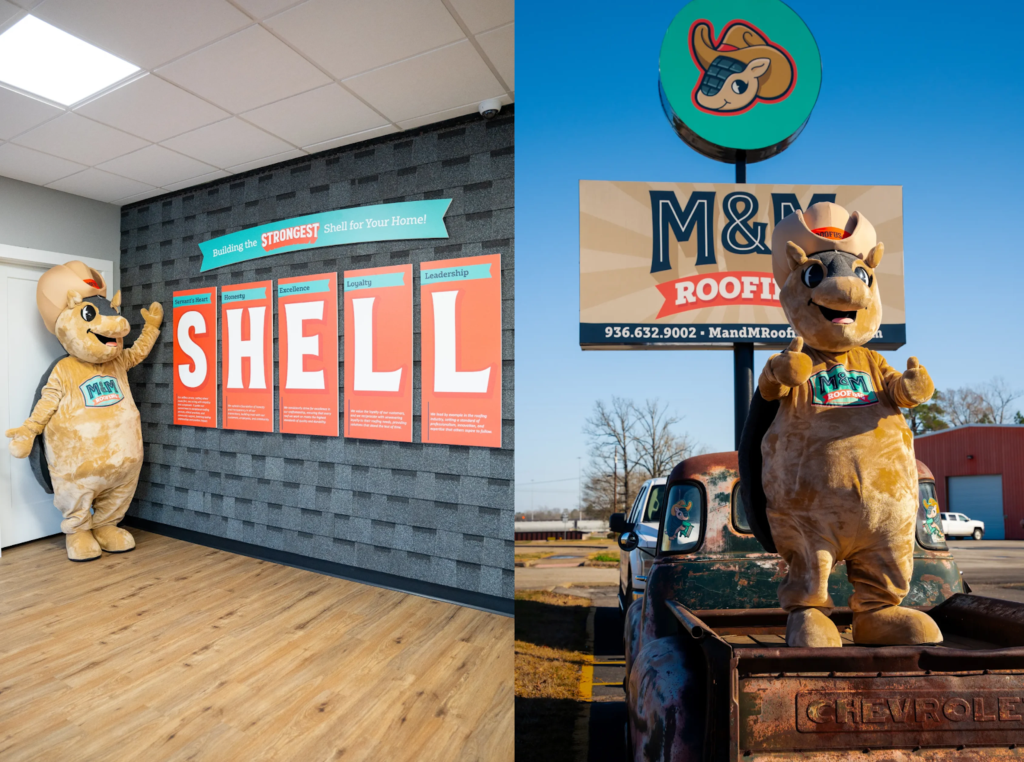
\If It Can’t Be Read in Three Seconds, It Fails
Most roofing logos fail not because they’re ugly, but because they’re unreadable. Someone scanning hundreds of branding impressions in a day (on trucks, uniforms, yard signs, or phones) decides in about three seconds whether your brand “makes sense” for them. If your logo requires more time to interpret, it’s already too slow.
On a truck wrap, your logo gets between one and three seconds of attention as someone drives by. If the text is too thin, the icon is too detailed, or the contrast is too low, it won’t register. Clean, bold, high‑contrast logos register faster and stick better.
Good contractors test this early. Print a mockup at the size it will appear on the side of a truck or on a shirt pocket, take a step back, squint a bit, and ask someone who doesn’t know your company to read it. If they hesitate, simplify. We suggest testing your logo in all formats and seeing how it looks. Check its visibility in display, social, and print settings before finalizing it.
Color and Typography: Function Before Flash
Color and font choices aren’t aesthetic luxury decisions. They are functional decisions that determine whether your logo works in the real world.
- Color matters. Use high contrast combinations like dark text on light backgrounds or light text on dark backgrounds, so your logo reads clearly outdoors under variable lighting conditions. Two or three strong colors are usually enough. Too many colors make printing and stitching harder, and gradients often disappear when embroidered on shirts.
- Typography matters just as much. Sans‑serif fonts (simple block fonts without decoration) and bold display fonts communicate strength and clarity. Roofers are often taught to choose what looks “nice,” but the reality is that nice fonts that are thin or fancy often go unreadable from a distance. Choose fonts that feel strong and functional first.
Logos Must Work Everywhere — Not Just on Screens
Designing a logo on a computer screen is easy. Making it work on real physical surfaces (like trucks and shirts) is where the challenge begins.
A logo that looks great on your website can fall apart in print or embroidery. Screens display anti‑aliased edges and thousands of colors. Shirts require stitching constraints. Trucks require durable vinyl and a readable scale. Good logos have:
- a one‑color version for embroidery
- a full‑color version for wraps and signage
- a secondary horizontal layout
- a primary stacked or centered layout
Testing matters. Print test logos at real physical sizes. Embroider sample shirts. Wrap a vehicle mockup. If any version loses readability or impact, simplify it.
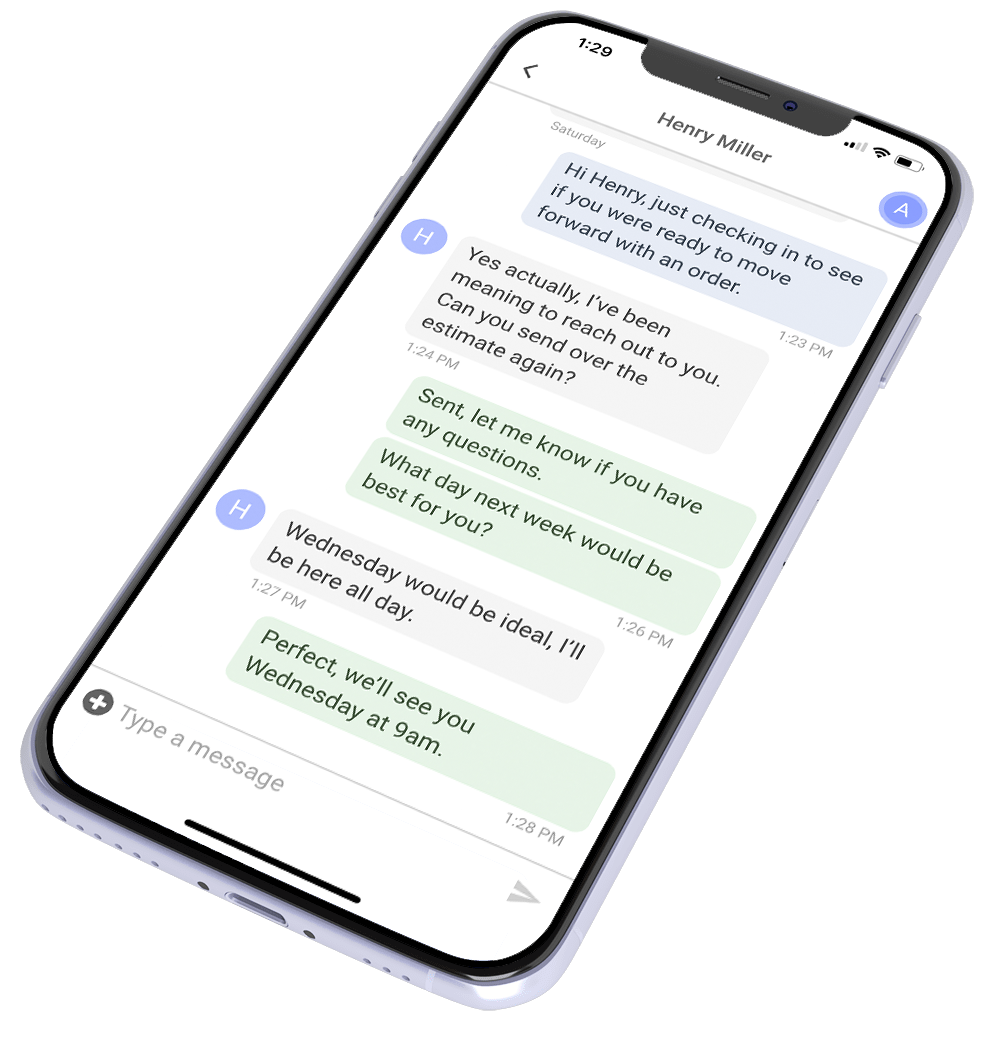
ProLine customers often tie their logo into every customer touchpoint (on quotes, automated emails, text message signatures, work orders, and invoices) to enforce a consistent brand experience. When customers see the same professional look from the first impression through delivery and follow‑up, it reinforces trust and credibility.
A Good Roofing Logo Makes Your Life Easier
One of the worst branding mistakes roofers make is treating the logo as the final hero of their marketing. Wrong! Logos aren’t the job closers. They are recognition engines.
- A strong roofing logo gets people to pause, remember you, and maybe click or call. The real job of branding is consistency, using that logo across every touchpoint so every impression compounds over time.
- Your website, estimate PDFs, social media profiles, yard signs, vehicle wraps, and even report headers should present the same brand. That doesn’t just look “put together.” It signals to homeowners that you run an organized company.
- Learn that clear, consistent branding increases trust and reduces price resistance on higher‑ticket services like roofing. So, a homeowner is likely to accept your estimate when your logo and communication feel professional and reliable.
ProLine helps roofers track how branded assets perform. You can tag where leads came from, see which wraps, signs, or materials generate calls, and build communication workflows that follow up instantly, increasing your chance of converting recognition into booked jobs.
One of the greatest marketing mistakes roofers make is not getting the right CRM.
Get A Logo That Helps You Close Business
Your logo shouldn’t be an afterthought. It should be a strategic asset that works wherever you show up… on the road, on job sites, on phones, and in inboxes.
- Designing a roofing logo that works on trucks and shirts means focusing on readability, simplicity, contrast, and consistency.
- It means testing in real conditions and pairing your visual identity with systems that support communication and conversions, like ProLine’s CRM.
- Recognition doesn’t close jobs by itself, but when your branding gets noticed quickly, and your follow‑up and communication are organized, you sell more jobs, keep your pipeline clean, and make it home for dinner.
If you want roofing branding that actually performs, i.e., paired with tools that help you convert recognition into calls, estimates, and booked jobs, you should then book a demo with ProLine and see how a communication‑first CRM helps you close more business with less chaos.
FAQs
Should I hire a designer or use an online logo maker?
Online tools are fine when you need something fast or low‑budget, but a professional designer who understands how logos behave in the real world often produces designs that perform better on trucks, shirts, and signage.
How many colors should a roofing logo use?
Two or three strong colors are usually enough. Too many colors complicate printing and embroidery. High contrast is more important than having lots of shades.
How do I know if my logo works on trucks and shirts?
Test it. Print at real sizes. View it at a distance. Show it in digital mockups of your vehicles and apparel. If it doesn’t read instantly, simplify.