Everyone talks about roofing franchise opportunities as if they are a clear path to ownership. The pitch usually sounds straightforward: you step into a proven brand, plug into existing systems, and start generating revenue faster than if you were building from scratch.
But once you are actually inside the model, the reality becomes more layered. A franchise gives you structure, not independence. It gives you tools, not automatic execution. And most importantly, it gives you a starting point, not a finished business. That distinction is where everything starts to split. After that, there are 109,000 roofing businesses in the US, and this industry has grown with a CAGR of 3.4% in the last five years. So, what’s the issue?
Some owners stay inside execution and end up “playing business.” Others use the same system to step out of operations and start “building a business.” Both can generate revenue, but only one creates scalability that does not depend on the owner’s daily involvement.
Why Roofing Franchise Opportunities Feel “Ready-Made” at First
On paper, roofing franchises are designed to reduce friction. They remove early-stage uncertainty and give you a structured environment to operate in from day one. Most franchise models typically include:
- A recognized brand name with built-in trust
- A defined sales and marketing framework
- Operational guidelines for job execution
- Training and onboarding support
- Access to tools and technology systems
That combination creates a strong illusion of completeness. It feels like the business is already built, and your role is simply to operate it. But that is where many new owners misread the model.
Because what you are actually receiving is not a self-running business. You are receiving a structured operating system that still requires someone to design how work flows through it. And in most cases, that responsibility still sits with the owner.
Playing Business: What It Looks Like in Real Roofing Franchise Operations
An average roofing business earns between $500k and almost $5 million in the US. Sadly, however, “playing business” does not usually feel like failure in real time. In fact, it often feels productive because things are constantly happening. Jobs are being sold. Crews are active. Money is moving. But underneath that activity, there is usually a pattern of dependency forming.
Common signs of playing business include:
- The owner is still the primary closer on most deals
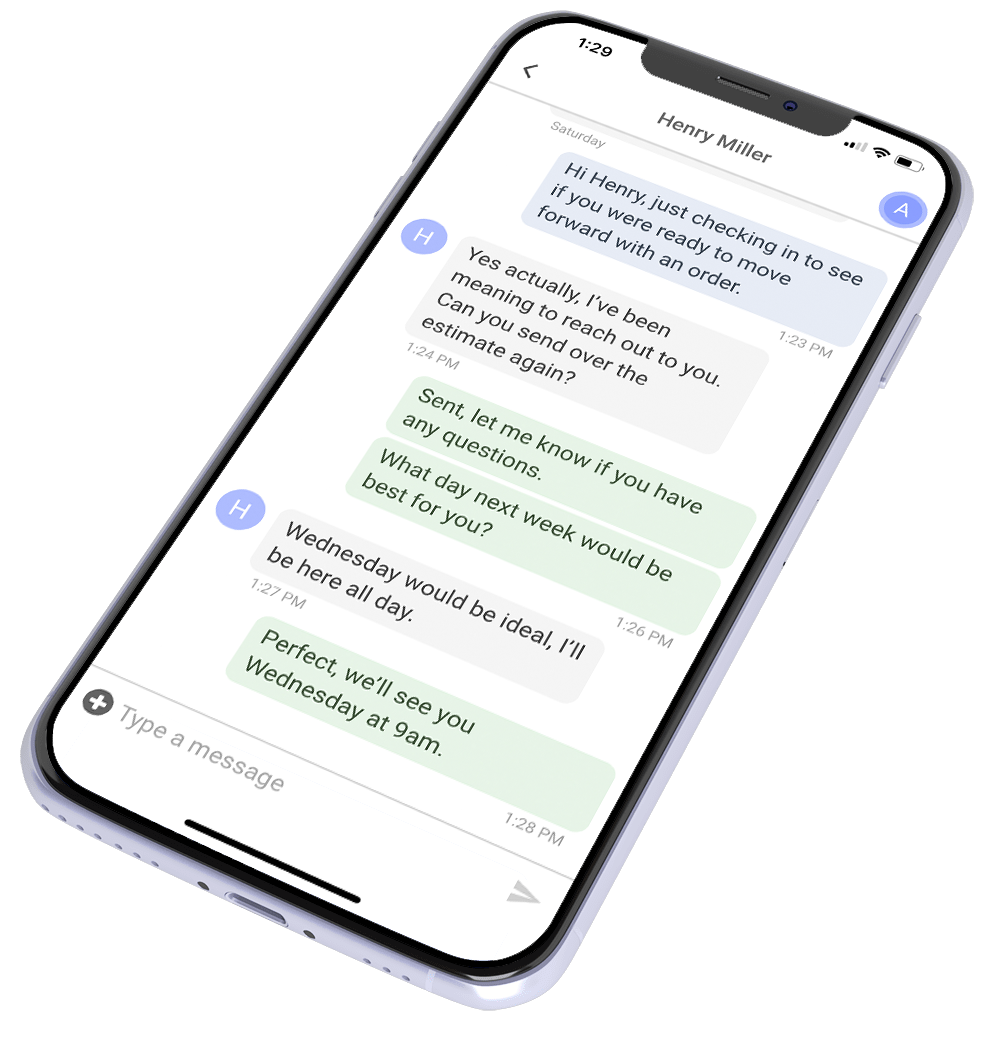
- Job updates depend on calls, texts, or informal communication
- Production decisions frequently escalate to one person
- Follow-ups are inconsistent or memory-based
- CRM usage is partial rather than system-driven
- Revenue is active, but not predictable
The business looks busy, but it is not structurally independent. This is also why many owners stay stuck here longer than expected. The system works just enough to feel successful, but not enough to remove the owner from the center of everything.
And as long as the owner remains the bottleneck, scaling becomes a time problem instead of a business problem.

Why This Stage Feels Productive But Caps Growth
The challenge with “playing business” is that it can still produce strong short-term revenue. That makes it harder to recognize as a limitation. But over time, a few patterns start to show up:
- Growth slows even when demand is strong
- Hiring does not reduce the owner’s workload
- Revenue increases, but stress does not decrease
- Operations become reactive instead of structured
At this stage, the business is no longer limited by opportunity. It is limited by internal structure. And that is where the shift toward building begins.
Building a Business: What Actually Changes Inside a Roofing Franchise
Building a business does not mean stepping away from work. It means changing what your work is focused on. Instead of managing individual jobs, you start managing systems that manage jobs. That shift usually involves three structural changes:
- Work becomes system-driven instead of owner-driven, so jobs move through defined stages without constant intervention.
- Communication becomes centralized instead of fragmented, which means that all updates live in one system instead of scattered conversations.
- Execution becomes distributed instead of centralized, i.e., your teams and tools handle daily operations without escalation to the owner.
This is where platforms like ProLine become important in practice. A communication-first CRM is not just a tracking tool. It becomes the operational layer that controls how information moves across sales, production, and office workflows.
Once that layer is in place, the owner is no longer required to “hold” the business together manually. If you want to scale your roofing franchise, you need to understand what a system-driven franchise actually looks like before you invest in different companies.
What a System-Driven Roofing Franchise Actually Looks Like
When a roofing franchise shifts into a system-driven model, the structure changes in very visible ways. Instead of informal coordination, you see defined workflows:
- Leads enter a structured pipeline automatically
- Follow-ups are triggered by system rules, not memory
- Job stages are visible across teams in real time
- Production updates flow through one platform
- Owners focus on exceptions, not daily operations
At that point, the business stops relying on constant decision-making at the top level. It becomes operationally self-contained.
Where Most Franchise Owners Get Stuck Without Realizing It
Comfort in control
Owners often step in because it feels faster and more reliable than relying on systems or delegation. When a customer issue escalates or a job needs immediate attention, taking control directly usually resolves the situation quicker in the moment.
The challenge is that this creates a long-term dependency loop. Instead of improving the system that could handle the issue next time, the business reinforces the idea that the owner is the default solution. Over time, that makes the owner the fastest problem solver in the business, but also the most overloaded and essential part of every workflow.
Short-term urgency
Roofing naturally operates in a high-pressure environment where urgency is constant. Weather, insurance timelines, customer expectations, and crew scheduling all push decisions toward immediate action rather than structural thinking.
Because of that pressure, it becomes easier to solve the problem in front of you rather than slow down and refine the system behind it. The result is a cycle where the same operational issues keep reappearing because the focus stays on fixing instead of preventing. This keeps the business reactive instead of structured, even when revenue is strong.
Lack of enforced systems
Most roofing franchises have systems in place, but the real issue is consistency in how those systems are used. A CRM might exist, but job stages are not always updated. A follow-up workflow may be defined, but it is not consistently followed when things get busy. Production tracking tools may exist, but teams still default to calls, texts, or informal updates.
This creates a split operating environment where two versions of the business exist at the same time. One is structured and visible inside the system, while the other runs informally through habits and urgency. When pressure increases, teams tend to revert to informal communication, and the owner steps in to keep things aligned, which slowly reinforces system bypass instead of system adoption.
Owner identity tied to execution
Many franchise owners still strongly identify as the person who gets things done directly, especially in high-pressure situations. That identity is often built through years of being the closer, the problem solver, or the most reliable person in the field or sales process.
While that identity helps early growth, it becomes a limitation at scale. Building a business requires shifting from being the executor to being the designer of execution. Instead of personally solving every problem, the focus shifts to building systems that solve those problems consistently without direct involvement.
Why Roofing Makes This Difference More Extreme Than Other Industries
Roofing is not a passive service business. It is highly operational, time-sensitive, and coordination-heavy. A typical roofing franchise operation includes constant movement across:
- Sales cycles that depend on fast follow-up
- Production schedules tied to weather and availability
- Insurance workflows with documentation requirements
- Field communication across crews and office teams
- Cash flow timing based on job completion cycles
When these elements are not systematized, everything naturally funnels back to the owner. This is why roofing exposes the difference between structured and unstructured businesses faster than most industries.
What Separates Operators Who Scale From Those Who Stall
The difference is not intelligence or effort. It is how early systems replace involvement. Owners who scale typically shift their focus toward:
- Building repeatable sales and production workflows
- Reducing dependency on direct communication
- Using CRM systems as operational infrastructure
- Hiring to remove themselves from execution
- Measuring process consistency instead of only revenue
They also tend to make a key decision early: systems are not optional; they are the business. Once that mindset shifts, everything else starts to compound.
The Real Question Behind Roofing Franchise Opportunities
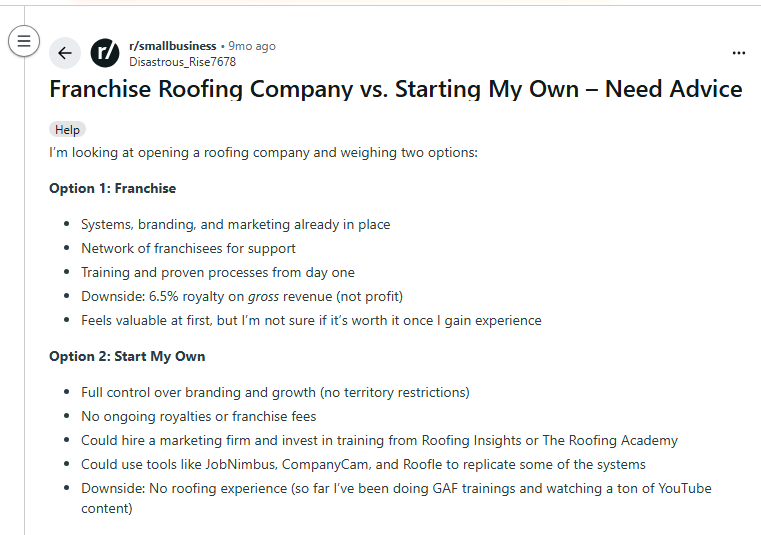
Most people evaluate roofing franchise opportunities by comparing them to starting independently. But that is not the real comparison. The real question is this:
Are you building a business that runs without you, or creating a structure that still depends on you to function?
Because both paths can look successful in the early stages. But only one eventually removes the owner from daily execution. And that difference determines whether the franchise becomes scalable or stays operationally capped.
Ready to Excel in the Business World as a Roofer?
Roofing franchise opportunities are not inherently limiting or inherently scalable. They are structured environments that require intentional system-building to unlock their full value.
Playing business keeps you inside execution, even when revenue is growing. It feels productive, but it eventually caps scale because everything still depends on the owner.
Building a business requires stepping back from execution and investing in systems that manage communication, production, and workflow consistency without constant oversight. The franchise provides the framework. But the structure you build inside that framework determines whether you stay inside the work or eventually move above it.
FAQs
What is the difference between playing business and building a business in roofing franchises?
Playing business means the owner is actively involved in day-to-day execution. Building a business means systems, workflows, and teams handle execution independently.
Why do roofing franchise owners stay stuck in operations?
Because roofing is highly reactive, and owners often default to solving problems directly instead of building systems that prevent repetition.
Can a roofing franchise work without the owner being involved daily?
Yes, but only when structured systems like CRM workflows, centralized communication, and clear operational processes are fully implemented.
What role does CRM play in scaling a roofing franchise?
A CRM centralizes job tracking, communication, and follow-ups, reducing dependency on memory and manual coordination across teams.
What is the biggest barrier to scaling a roofing franchise?
Owner dependency. When too many decisions and workflows rely on the owner, the business cannot scale beyond their personal capacity.