
If you ask ten contractors, “What is the average cost of roofing insurance supplements?”, you’ll get ten slightly different answers, and all of them will be partially right. That’s because there is no fixed price for a roofing insurance supplement in the traditional sense. A supplement is not a standalone product with a set fee. It is an adjustment to an insurance claim that corrects missed scope, incorrect pricing, or incomplete line items in the original estimate.
So when contractors talk about the “cost” of supplements, what they are really referring to is the additional claim value recovered after the initial insurance estimate has already been issued.
In practical roofing operations, that recovered value tends to fall into fairly predictable ranges. Some claims only need minor corrections. Others uncover thousands of dollars in missing scope once production begins and the roof is actually opened up.
The important shift in thinking is this: supplements are not an expense category. They are a revenue recovery mechanism within insurance work.

Why insurance supplements exist in roofing claims
Insurance supplements exist because initial claim estimates are based on pre-loss inspections, standardized estimating tools, and limited visibility into actual roof conditions.
Even with modern estimating platforms, insurance adjusters are often working with incomplete information. They are not on the roof during tear-off, and they are not seeing what contractors see once work begins. This creates a natural gap between:
- What the insurance carrier initially approves
- What the actual scope of work turns out to be
That gap is where supplements live. Common reasons supplements are required include:
- Hidden decking damage discovered after tear-off begins
- Local building code requirements not included in the original estimate
- Missing labor components for steep slopes or complex roof geometry
- Underestimated material quantities or outdated pricing data
- Omitted accessories such as drip edge, flashing, or ventilation systems
- Disposal, haul-off, or dump fees not fully captured in the original scope
Industry guidance describes supplements as adjustments meant to correct “omitted or underestimated items discovered after work begins or during detailed inspection.”
That definition is important because it reinforces the core idea: supplements are not optional add-ons. They are corrections to ensure the claim matches the real cost of completing the work properly.
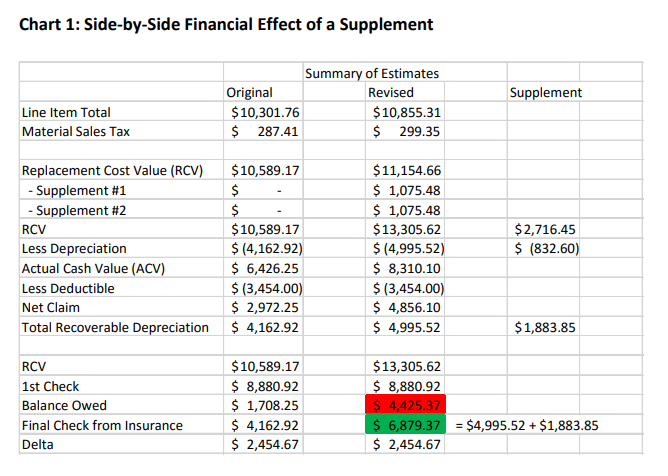
Typical roofing insurance supplement ranges per claim
The 20% rule states that roofing insurance estimates are usually light. While there is no universal pricing table, roofing contractors consistently see supplements fall into three broad tiers depending on claim complexity and scope gaps.
Small residential adjustments
These are the most basic supplements and usually involve minor corrections or missing line items.
- Typical range: $250 to $1,000 per claim
- Common triggers:
- Missing accessories like pipe boots or starter shingles
- Small repair items discovered during installation
- Minor disposal or labor adjustments
- Small code-related corrections
These supplements are often easy to miss if documentation is not tightly managed, even though they occur frequently across residential jobs.
Standard residential replacement supplements
This is the most common supplement range for full roof replacements in insurance-driven roofing businesses.
- Typical range: $800 to $2,500 per claim
- Common triggers:
- Labor rate adjustments for real market conditions
- Underestimated tear-off complexity
- Additional layers or decking replacement discovered mid-job
- Measurement discrepancies between estimate and actual roof conditions
- Missing ventilation or flashing requirements
At this level, supplements are no longer about small corrections. They are about aligning the insurance scope with real production conditions.
Complex or storm-related supplements
These occur on higher-damage roofs, storm claims, or properties with structural complexity.
- Typical range: $2,000 to $8,000+ per claim
- Common triggers:
- Extensive decking replacement after tear-off
- Code-required upgrades triggered by jurisdiction rules
- Multi-layer tear-offs requiring additional labor and disposal
- Steep pitch or safety-related labor adjustments
- Full system corrections not included in initial scope
These are the claims where experienced contractors often see the biggest difference between companies with a structured supplement process and those without one.
The real driver behind supplement value: scope gap
The most important concept in understanding supplement “cost” is this: the supplement value is directly tied to the gap between estimated scope and actual scope. That gap is influenced by several variables:
- Accuracy of the original inspection
- Quality of satellite or estimating software data
- Complexity of roof design and structure
- Local code enforcement requirements
- Contractor documentation quality during production
Two identical roofs can produce completely different outcomes depending on how well the scope gap is identified and documented.
One contractor may recover a few hundred dollars. Another may recover several thousand from the same type of project simply because they tracked and justified every missing item.
How supplement frequency affects total annual revenue
The “average cost per supplement” is only part of the picture. The real financial impact comes from how often supplements are captured across a roofing operation. In insurance-heavy roofing businesses, it is common to see:
- A supplement opportunity on every 2 to 4 insurance jobs
- Higher frequency during storm cycles or catastrophic weather events
- Larger supplement values in markets with strict building code enforcement
When viewed at scale, supplements become a recurring revenue layer rather than isolated exceptions. For example, a contractor completing 75 insurance jobs per year may only need a modest capture rate to generate significant additional revenue without increasing lead flow or sales activity.
Why most contractors under-recover supplements
Even though insurance supplements are a normal and expected part of roofing work, a large number of contractors still fail to capture their full value consistently. It is rarely a problem of demand or opportunity. The real issue is that most teams do not have a repeatable process that ensures every eligible supplement is identified, documented, submitted, and followed through to completion.
In practice, supplements get lost in the gaps between sales, production, and administration. Each team assumes someone else is handling the details, and small breakdowns compound into missed revenue across the entire job pipeline. If you want to boost your roofing sales, you need to keep these details in mind. The most common breakdown points include:
1. Inconsistent documentation
Photos, measurements, and job notes are often captured in the field, but they are not consistently structured in a way that supports insurance submission requirements. In many cases, documentation exists, but it is scattered across texts, phone storage, or disconnected folders.
More importantly, it is frequently not tied directly to specific insurance line items. That disconnect makes it harder to justify scope changes later, even when the work is clearly legitimate. Over time, this leads to avoidable underpayment simply because the supporting evidence is incomplete or poorly organized.
2. Missed scope reviews
A major failure point happens before the job even begins. The initial insurance estimate is received, but it is not always reviewed carefully against actual site conditions or production requirements.
In fast-moving roofing operations, it is common for estimates to move directly into scheduling without a structured line-by-line comparison. That means missing items are often discovered too late, after materials are ordered or work has already started, when correcting the claim becomes more difficult and less efficient.
A proper scope review step is what separates reactive adjustments from planned, recoverable supplements.
3. Weak follow-up discipline
Submitting a supplement is only the beginning of the process, but many contractors treat it as the final step. Once the paperwork is sent, there is often no structured system to track status, response time, or required follow-ups.
Insurance carriers operate on their own timelines, and without consistent follow-up, supplements can sit unresolved for weeks or even months. In many cases, approvals are not denied outright; they are simply delayed due to lack of persistence or visibility from the contractor side.
Without a defined follow-up cadence, even well-prepared supplements lose momentum.
4. Lack of system visibility
In many roofing companies, supplements are tracked informally rather than as part of a centralized system. They may live in email threads, spreadsheets, or individual team members’ notes, rather than a shared operational dashboard.
This creates a visibility problem across the business. Leadership cannot easily see how many supplements are open, what stage they are in, or where bottlenecks are forming. As a result, opportunities age out unnoticed, and revenue recovery becomes inconsistent across different jobs and teams.

How systems change supplement outcomes
The difference between average and high-performing roofing contractors is rarely technical knowledge alone. It is a system structure.
When supplement tracking is manual, outcomes are inconsistent. When it is built into a structured workflow, results become repeatable. In a systemized environment, a roofing CRM helps by:
- Triggering a supplement review automatically for every insurance job
- Centralizing documentation at the job level
- Tracking open supplements as part of the pipeline
- Creating structured follow-up reminders until resolution
This is where communication-first platforms like ProLine become relevant, because supplements stop being a side task and become part of the job lifecycle itself rather than an afterthought.
Why the “average cost” is less important than total recovered value
Focusing only on per-claim averages can hide the real financial impact of supplements. A more useful way to look at it is annual recovery. For example:
- 60 insurance jobs per year
- Average supplement opportunity: $1,500
- Conservative capture rate: 15–25 recovered supplements annually
That translates into:
- $22,500 to $37,500 in additional revenue
- Without increasing marketing spend or job volume
This is why experienced contractors stop thinking about supplements as “extra income” and start treating them as structured margin recovery.
Never Lose Money on Roofing Jobs Again
There is no single fixed cost for roofing insurance supplements because they are not standalone transactions. They are corrections to insurance scopes that reflect the real cost of completing roofing work properly.
In most roofing operations, supplements typically range from a few hundred dollars to several thousand dollars per claim, depending on complexity, documentation quality, and scope gaps. The real question is not how much a supplement “costs.” It is how much revenue is currently being left unclaimed due to incomplete processes.
When tracked properly, supplements shift from unpredictable add-ons to a consistent and measurable revenue layer inside every insurance-driven roofing business. So, get a CRM like ProLine to make sure you never lose money on roofing jobs in the future!
FAQs
What is a roofing insurance supplement?
A roofing insurance supplement is a request to adjust an insurance claim to include additional work, materials, or labor that was not included in the original estimate.
How much do roofing insurance supplements usually add per claim?
Most supplements range from $800 to $2,500 for standard residential jobs, with smaller adjustments starting around $250 and complex claims exceeding $8,000.
Are supplements guaranteed to be approved?
No, supplements are not guaranteed. Approval depends on documentation quality, justification of scope, and alignment with insurance estimating guidelines.
Why do insurance companies miss items in roofing estimates?
Items are often missed due to limited inspection visibility, standardized estimating assumptions, or a lack of awareness of local building codes and real job conditions.
What is the best way to increase supplement recovery rates?
The most effective method is consistent documentation, structured scope reviews, and a systemized follow-up process that tracks every supplement until resolution.